
If you have ever opened an online discussion and been met with silence, the cause was probably not your students. It was more likely that they were not yet ready for the task you set. Gilly Salmon’s five stage model describes why, and what to do about it. This post explains the model in plain terms and shows how to use it when you build content in Canvas.
Learning outcomes
By the end of this post you’ll be able to
- Explain the five stages of Salmon’s model and the role of the online tutor in each.
- Apply the model to sequence the activities in one Canvas module.
- Design a first-week task that helps students access and join the course.
What the five stage model is
Gilly Salmon developed the model to describe how people learn together online. It sits within her work on e-moderating, which is the name she gives to the tutor’s role in guiding online groups. The central idea is simple. Learners move through five stages, and each stage needs a different kind of support from you.
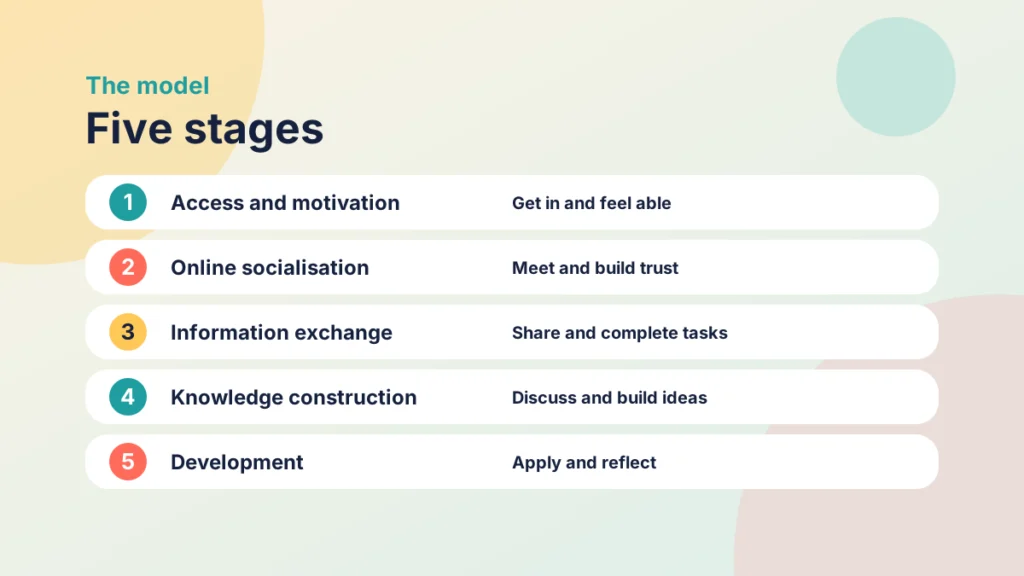
- Access and motivation: learners get into the system and feel able to take part.
- Online socialisation: learners meet each other and begin to build a community.
- Information exchange: learners share resources and complete set tasks.
- Knowledge construction: learners discuss, challenge and build understanding together.
- Development: learners take responsibility for their own learning and apply it to their own context.
Salmon wrote the model around text-based, asynchronous conversation, such as forums and email. The tools have moved on, but the people have not. A new student still has to find the course, work out how it behaves and decide whether it is safe to speak. Those worries come before any serious discussion.
It also explains why a lively discussion in one cohort can fall flat in another. The difference is often not the question but the amount of groundwork that came before it. A group that has already shared small things will risk sharing bigger ones.
Two cautions are worth keeping in mind. The stages are not a strict timetable, and learners can drift back a stage when something new is introduced, such as a new tool or a new group. The model also describes how a group moves, so you will often find individuals at different stages in the same week.
If you already use a framework such as the Introduction to the PANDA Framework, the model slots in comfortably. PANDA helps you structure a course, and the five stages help you decide how demanding each part should be and when. Gagné’s nine events makes a useful comparison, because it is concerned with the sequence inside a single lesson, while Salmon is concerned with the progress of a group over time.
Try it yourself
Match each stage to what learners do
Choose what learners are mainly doing at each of Salmon’s five stages, then check your matches.
Stages one and two: access, motivation and socialisation
The first two stages are where most courses lose people, and they are the stages that get the least time in many designs. Content arrives on day one, and the assumption is that students will work out the rest.
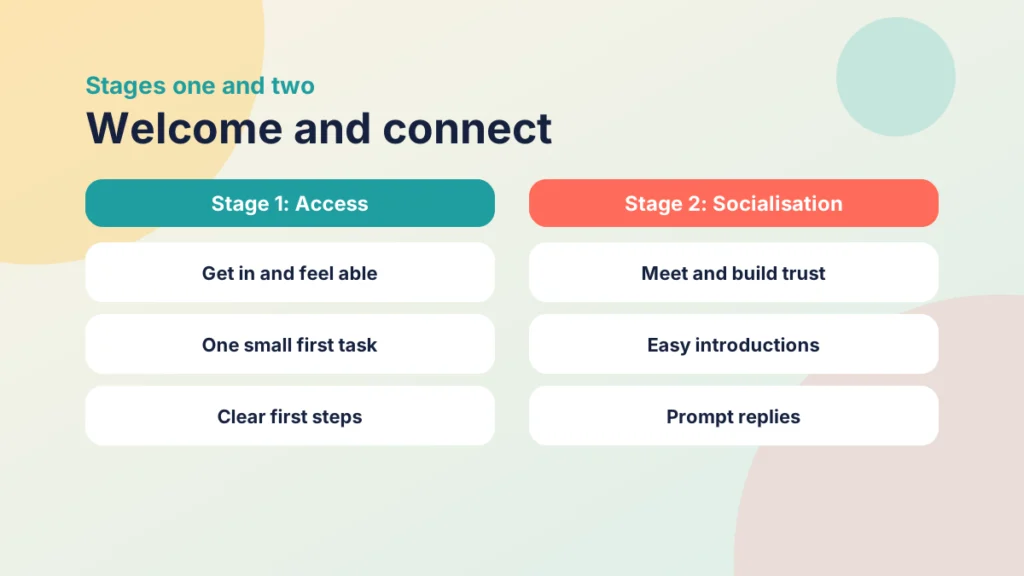
At stage one, your aim is to get every student in and feeling capable. They need to know where to start, how to log in, what to do first and how to ask for help. A short first task that can only succeed is better than a long welcome page. If students complete something small in the first day, they are more likely to return on the second.
It also helps to say what you will do. Tell students when you will check the course and how quickly they can expect a reply. A predictable tutor is reassuring, and it stops students from wondering whether anyone is reading.
At stage two, your aim is to help students meet each other. This is not social filler. People take part more readily in a group where they have said something and been answered. Salmon describes the tutor’s job here as building bridges, which means linking people, noticing contributions and responding promptly so that the first posts do not hang unanswered.
Put it into practice
Try it in Canvas
- Select Modules in Course Navigation and create a module named “Start here”.
- Add a Page with a short welcome, a list of what students need to do first and who to contact for help.
- Add a first task that takes a few minutes, such as confirming they can open a file or post a short reply.
- Select Discussions, choose + Discussion and write an introductions prompt that asks for one easy-to-answer detail.
- Publish the module and the discussion, then reply to the first few posts yourself.
Put it into practice
Your turn
Look at the first week of one of your courses. List what a student must do before they can take part in the first graded activity. Remove or simplify anything that is not essential.
Stages three and four: information exchange and knowledge construction
By stage three, students are comfortable enough to work with content. They share resources, complete set tasks and begin to use the course materials. This is the stage most Canvas courses are built for, which is why it can feel as though a course starts here.
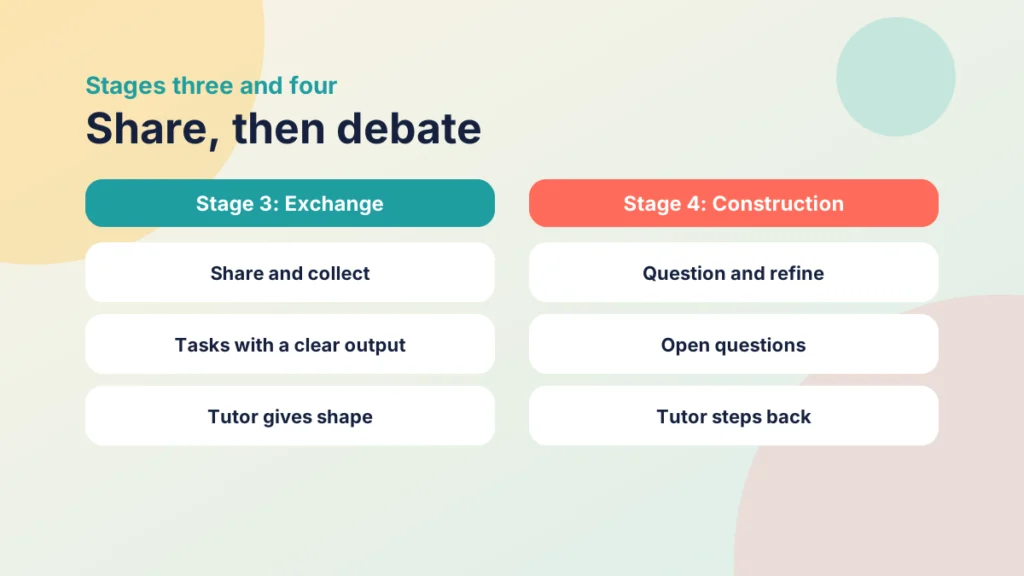
Your role is to give tasks a clear shape. A good stage three task says what to do, how long it should take, what to produce and where to post it. Vague instructions create a different sort of silence, because students do not know what a good contribution looks like.
Stage four is where the real conversation begins. Students move from exchanging information to building understanding together. They question each other, compare views and refine their ideas. This only works when the group has already settled at stages one to three.
Here you do less talking and more steering. Ask open questions that have more than one defensible answer, then step back to let the replies come. If you answer every post, students learn to wait for you. If you leave gaps, they begin to answer each other. This is also a good moment to consider the level of thinking you are asking for, and The New Bloom’s Taxonomy: A Practical Guide for New Academics is useful for choosing verbs that move students from describing to evaluating.
It is tempting to jump straight to stage four, because that is where the interesting talk happens. Resist the urge. A group that has not yet shared and settled tends to produce polite agreement, and polite agreement is not the same as understanding.
A practical difference between the two stages is the type of question. At stage three, you might ask students to summarise a reading and post it. At stage four, you might ask them to choose the weakest argument in the group’s summaries and explain why.
Put it into practice
Your turn
Take one discussion you currently use. Decide whether it is really a stage three task, where students share, or a stage four task, where they debate. Rewrite the prompt so that it matches the stage you intended.
Stage five: development
At stage five, learners take charge. They apply ideas to their own settings, reflect on what they have learned and judge their own progress. The tutor’s role shifts again, to supporting and responding rather than leading.
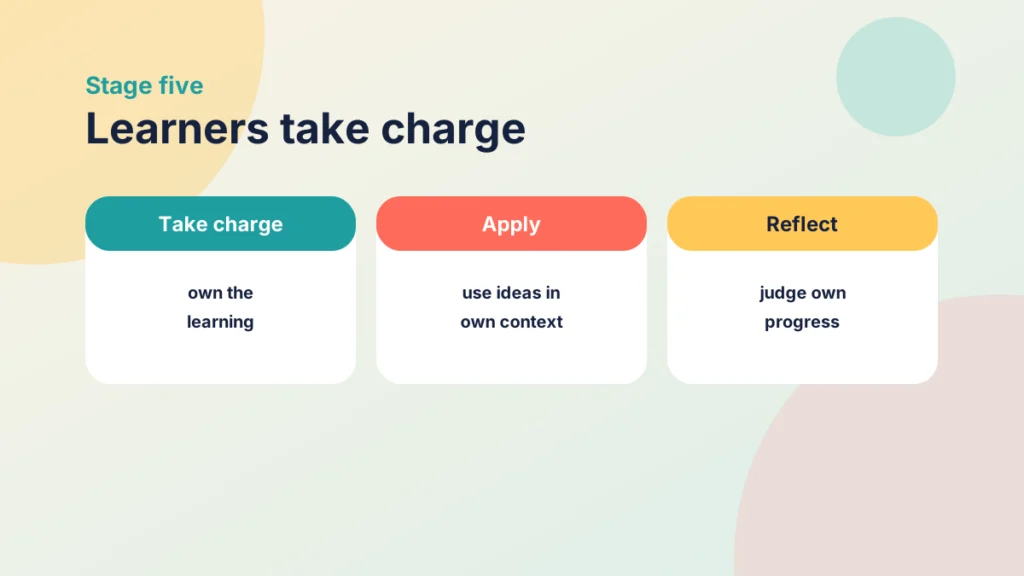
Stage five is also where students are most likely to surprise you. Because they are applying the material to their own work, their contributions go beyond what you planned. That is a sign the design is working, and it is worth leaving room for it.
This is often the stage that is missing. A course ends with a final assignment, and nothing invites students to look back and ask what they would do differently. A reflective task, a personal action plan or a short piece that applies the module to their own work can all serve this stage.
It also suits assessment that students own. If they choose a topic, justify the choice and relate it to their own practice, they are working at stage five. That connects to the guidance in 5 Tips for Building Effective Rubrics in Canvas, which can help you set criteria that reward reflection as well as accuracy.
Case study
Waiting for the discussion to start
Illustrative example
The context
A first-year module at a UK university has an online discussion each week, and the tutor wants students to debate case studies.
The challenge
Students posted once, at the deadline, and rarely replied to each other.
What they did
The tutor added a short introductions task in the first week, replaced a long welcome page with a clear first step, and made the early discussion prompts simple summaries. Open debate questions arrived from week four, once students had replied to each other several times.
What happened
The early posts arrived sooner, the replies grew gradually and the later debates drew on earlier summaries rather than starting from nothing.
What would you do?
- At which stage do your own students seem to stall?
- What would you add before the first debate to prepare for it?
Using the model to plan a Canvas course
You can use the model as a planning tool. Take your course outline and mark where each stage appears. Most weak designs have stage three in week one and stage four in week two, and nothing before or after. Spreading the stages across the term gives students time to settle before they are asked for more.
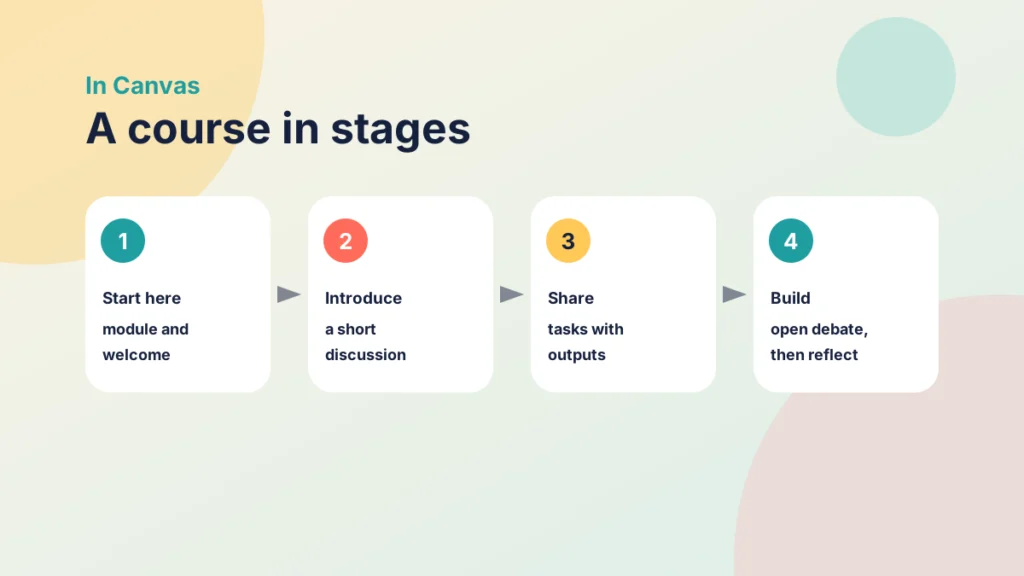
In Canvas, the stages map naturally onto tools you already use. A “Start here” module supports stage one, a short introductions discussion supports stage two, tasks with a clear output suit stage three, open discussion questions suit stage four, and reflective assignments suit stage five. If you are unsure how to organise the pages and modules that carry this, Driving Canvas: Modules vs Pages will help.
Remember that the model is a guide rather than a rule. A course for experienced learners who already know each other may skip quickly through the early stages, and a short course may compress several into a single week. The test is always whether your students are ready for the task you have given them.
Finally, it helps to join the model to the wider question of what makes a course engaging. The post on creating engaging and effective learning experiences links several frameworks together, and 5 Tips for Gamification in Canvas offers ideas for keeping students motivated at the early stages.
Try it yourself
Explore the five stages
Choose a stage to see what learners do, what you do as the tutor and one idea for Canvas.
Check your understanding
Knowledge check
Name the five stages of Salmon’s model in order.
Access and motivation, online socialisation, information exchange, knowledge construction and development.
Why does a long welcome page often fail at stage one?
Students need a small first step they can complete, because a short success builds the confidence to return.
What is the difference between a stage three and a stage four task?
Stage three asks students to share or exchange information, while stage four asks them to question and build understanding together.
What does the tutor’s role change to at stage five?
From leading to supporting and responding, so students take responsibility for their own learning.
Can learners move back a stage?
Yes. A new tool, group or topic can pull learners back, so the model is a guide rather than a strict timetable.
Remember
Key takeaways
- Salmon’s model has five stages, from access and motivation to development.
- Each stage needs a different kind of support from the tutor.
- Most courses lose people at stages one and two, so give them time.
- A clear first step works better than a long welcome page.
- Use the model to spread tasks across the term rather than front-loading them.
Your next step
This week, choose one module and label each activity with the stage it belongs to. Look for gaps, especially an early stage that is missing, and add one small activity to fill it. Afterwards, notice whether students post sooner and reply to each other more.
Reflect: at which stage do your own students most often go quiet, and what could you change before that point?