If you have just started teaching in higher education, you will probably be asked, sooner or later, to write learning outcomes. When that happens, someone will mention Bloom’s taxonomy. What many new academics do not realise is that the version most often used today is not the 1956 original but a revision published in 2001. This post calls that revision the new Bloom’s taxonomy. It is still widely used, it is easy to learn, and it becomes surprisingly useful once you see what it is for. Here is what changed, how the six levels work in practice, and how to use the taxonomy to write better outcomes and assessments. No prior knowledge is assumed.
Where the taxonomy came from
Benjamin Bloom and a group of colleagues published their classification of educational objectives in 1956. It focused on what they called the cognitive domain, meaning the kinds of thinking that teaching aims to develop. Their aim was practical: to give teachers and examiners a shared language for describing what students were expected to do. Later work extended the idea to affective and psychomotor domains, but the cognitive domain is the one that most teachers meet.
Over the following decades the taxonomy became a standard reference in curriculum design. In 2001 a team led by Lorin Anderson and David Krathwohl, one of the original authors, published a revision called A Taxonomy for Learning, Teaching, and Assessing. The revision updated the framework in light of later thinking about learning, and it was designed to be more useful for planning teaching, not only for classifying objectives. If you meet a staircase diagram with the verbs remember, understand, apply, analyse, evaluate and create, you are looking at the revised version.
What changed in the revision
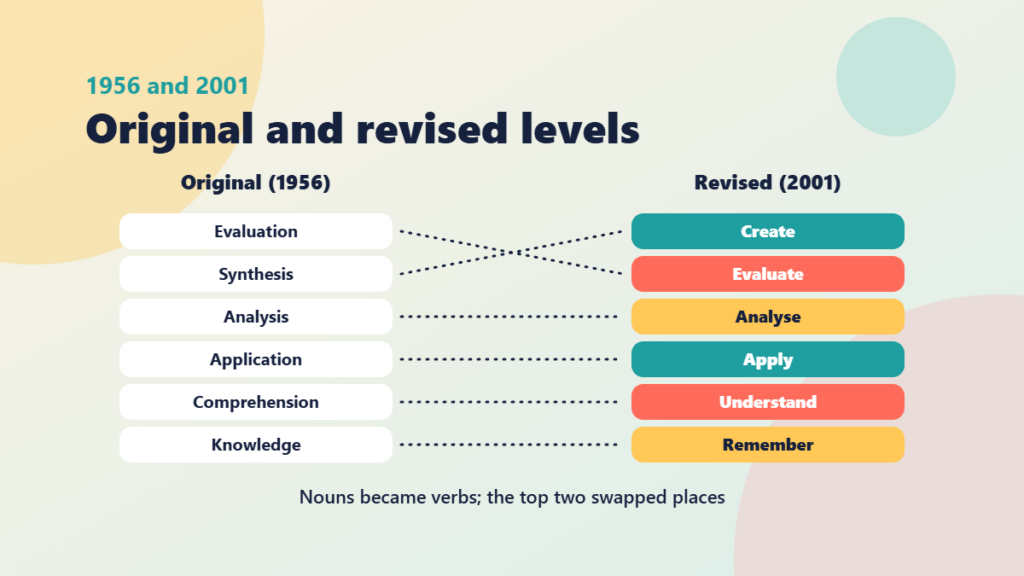
The revision kept the spirit of the original, but made three changes that matter for everyday teaching. The diagram below shows how the original categories map to the revised ones.
Nouns became verbs
The original categories were nouns, such as knowledge and comprehension. The revised levels are verbs, such as remember and understand. This sounds minor, but it changes how you use the framework. Learning outcomes describe what students will do, and verbs describe actions, so the revised labels slot straight into the sentence “By the end of this session, students will be able to…”.
Two levels changed places
In the original taxonomy, evaluation sat at the top, with synthesis just below it. In the revision, creating sits at the top and evaluating moves down one step. The authors treat producing something new as among the most demanding things students can be asked to do. You do not need to defend that ordering to use the framework. It is enough to know that the top two levels are close neighbours, and that tasks often draw on both.
A second dimension: types of knowledge
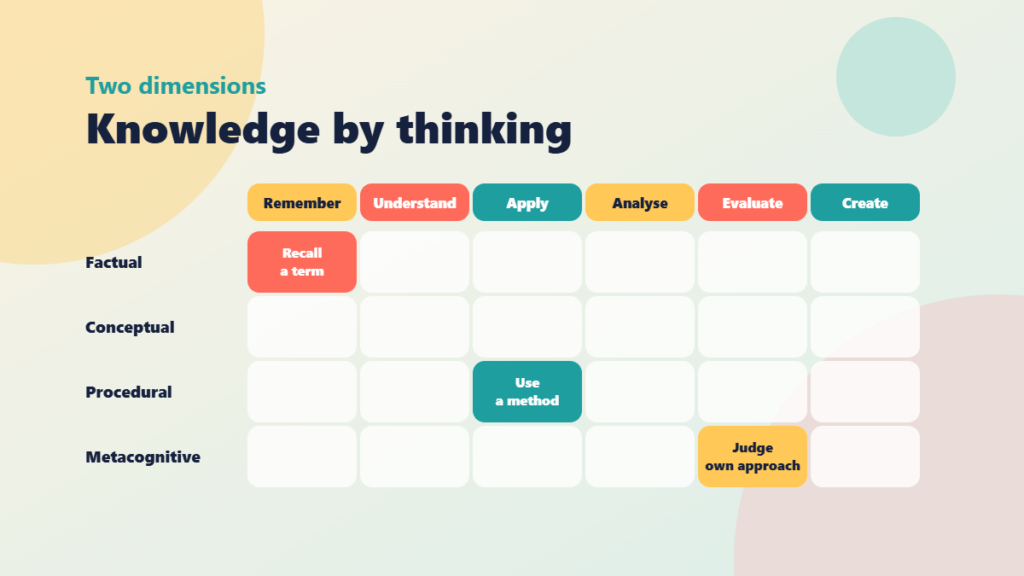
The most important change is easy to miss. The revision separates the kind of thinking (the cognitive process) from the kind of knowledge being thought about. It describes four types of knowledge:
- Factual: terms, facts and basic elements of a subject.
- Conceptual: how ideas relate to each other, such as theories, models and categories.
- Procedural: how to do something, including methods and criteria for choosing between them.
- Metacognitive: awareness of your own thinking and learning, including knowing which strategies work for you.
Combining the two dimensions gives a grid. A student might remember a factual term, apply a procedural method or evaluate their own approach, which is a metacognitive task. The grid reminds you that a level such as analyse can apply to facts, concepts, procedures or students’ own thinking, and that the right task depends on both.
The six levels in practice
Each level has typical verbs and typical tasks. The examples below come from a research methods course, but you can translate them to any discipline.
Remember
Remembering means retrieving information from memory: define, list, name, recall or recognise. An example outcome is “List the main stages of a research project.” This level is the foundation for everything else, and short low-stakes quizzes are an efficient way to practise it.
Understand
Understanding means making sense of material: explain, summarise, classify or give examples. An example outcome is “Explain in your own words why random sampling matters.” Students who can only repeat a definition have not yet shown understanding, so ask them to rephrase or give an example of their own.
Apply
Applying means using a procedure in a particular situation: use, solve, carry out or implement. An example outcome is “Use a coding framework on a short interview extract.” The key is that the situation is new to the student, because repeating a worked example is closer to remembering.
Analyse
Analysing means breaking material into parts and seeing how they relate: compare, distinguish, organise or deconstruct. An example outcome is “Compare the designs of two studies and identify how each affects its conclusions.” Analysis is often where students begin to think like members of the discipline.
Evaluate
Evaluating means making judgements against criteria or standards: judge, critique, justify or defend. An example outcome is “Critique the methods of a published study against agreed criteria.” Without criteria, an evaluation becomes an opinion, so make the standards explicit.
Create
Creating means putting elements together to form something new: design, plan, produce or construct. An example outcome is “Design a small study to answer a question in your own field.” Creating draws on every lower level, which is why it takes time and usually suits later stages of a course.
One topic at six levels
A worked example makes the levels easier to see. Imagine a session on peer review in a science or social science course. The same topic can be taught and assessed at every level.
- Remember: name the stages of the peer review process.
- Understand: explain why journals ask independent experts to review a manuscript.
- Apply: use a review checklist on a short sample paper.
- Analyse: compare two reviewers’ reports and identify where and why they disagree.
- Evaluate: judge whether an editor’s decision was justified, using the journal’s published criteria.
- Create: draft a constructive review of a paper in your own field, or design an improved review process.
Notice that the topic never changes. What changes is the thinking you ask for, and therefore the evidence you need. You would not teach all six in a single hour, but laying them out like this helps you decide which ones this session is really about.
Why it matters when you are new to teaching
As a new academic you are often handed a module that already exists, or asked to design one quickly. The taxonomy gives you a shared language for conversations with colleagues, external examiners and quality reviewers, who will often expect to see outcomes written in this way. It also helps you notice when a course has drifted. If every assessment in a module sits at the remember and understand levels, students may leave without ever practising the judgement the discipline values. If every task demands creation from week one, students may be missing the foundations they need.
It is also a useful tool for talking with students. Telling them what level of thinking a task requires, and why, makes expectations clearer. Many students assume that a good answer is a long description. Showing them the difference between describing, analysing and evaluating can change how they approach their writing.
Writing learning outcomes with the taxonomy
Outcomes are the most common reason new academics meet the taxonomy, and it helps with each part of the job.
- Start with an observable verb. Words such as explain, compare or justify describe actions you can see. Words such as understand, know or appreciate describe states you cannot observe directly.
- Use one main verb per outcome. An outcome that asks students to “analyse and evaluate and create” is really three outcomes, and it will be hard to assess.
- Choose the level for the stage of the course. A first-year module will often concentrate on remembering, understanding and applying, while later modules lean more on analysing, evaluating and creating.
- Keep the number small. A handful of outcomes per session or week is easier to teach and assess than a long list.
Here is a short before and after. “Students will understand research ethics” is vague. “Explain the main ethical principles that apply to research with human participants” is clearer, and “Evaluate the ethical risks in a proposed study design” is clearer still and aims higher. Each tells students and colleagues what will be expected.
Matching assessment to outcomes
Outcomes only help if the assessment matches them. This idea is often described as constructive alignment: the teaching, the activities and the assessment all point at the same intended learning. The taxonomy gives you a quick check, because each level suggests the sort of task that provides evidence for it.
- A short recall quiz can show remembering.
- An explanation in the student’s own words can show understanding.
- A problem set or case task with a new situation can show application.
- A comparison or a breakdown of an argument can show analysis.
- A critique judged against criteria can show evaluation.
- A design, plan or original product can show creation.
The most common mismatch is an ambitious outcome with a modest task. If an outcome says “evaluate” but the exam asks students to list facts, the exam is measuring something else. Ask yourself what would convince you that a student has met the outcome, and then check that the task provides it.
Using it with PANDA and Canvas
If you build courses on a weekly structure such as PANDA (Prepare, Activate, Navigate, Demonstrate and Articulate), the taxonomy fits naturally. Write your outcomes with taxonomy verbs in Prepare. Use remembering and understanding in Activate and Navigate. Make sure each Demonstrate task matches the level of its outcome. Use Articulate to invite students to evaluate their own learning, which links to the metacognitive dimension.
In Canvas, this means choosing tools to suit the level. Quizzes suit recall and understanding, and Assignments with rubrics suit application and analysis. A discussion or an assignment can host evaluation and reflection, and media recordings let students explain or present. When you write a rubric, use the same verbs as the outcome, so that the task and the marking stay aligned.
Common misunderstandings
- “It is a strict ladder.” Students do not need to master every lower level before attempting a higher one, and real tasks often combine levels.
- “Higher is always better.” Remembering and understanding are the foundations of higher-level work. A course that only aims at the top levels may leave gaps.
- “The verb decides the level.” A verb is a clue. “Explain” can mean repeating a textbook definition or building an original argument, so check the task as well as the word.
- “Every session must reach Create.” It should not. Choose the levels that fit the purpose and the stage of the course.
- “It explains how learning works.” The taxonomy is a classification tool for describing outcomes and tasks. It is not a theory of how people learn.
You may also meet adaptations, such as digital versions of the taxonomy that suggest verbs for online activities. They can be a helpful source of ideas, but they build on the same six levels.
Practical starting points for new academics
- Pick one module or session you teach and list its current outcomes.
- Underline the verbs, and replace any vague ones with observable actions.
- Label each outcome with its level and its type of knowledge, and check that the levels suit the stage of the course.
- Look at each assessment task and ask whether it gives evidence at that level.
- Share your outcomes with a colleague and ask whether they would recognise the same level of thinking.
Getting started
You do not need to master the whole framework at once. Begin with outcomes: choose clear verbs, keep the number small and check that your assessment matches. As you gain confidence, bring in the knowledge dimension and use it to design richer tasks. Over time the taxonomy becomes a habit of mind, a quick way to ask what kind of thinking you are really asking students to do.