Articulate is the final element of the PANDA framework (Prepare, Activate, Navigate, Demonstrate, Articulate). It is the moment in the week when students put into words what they have learned. Done well, it also does something more valuable: it links the week’s outcomes to what students already knew, so that new learning attaches to existing understanding instead of floating free of it.
What Articulate is for
Demonstrate asks students to show what they can do. Articulate asks them to explain their thinking, reflect on the process and say what it means for them. For academics, this makes learning visible. You see not only whether students got the answer but how they understand the topic, where they are unsure and what they plan to do next.
Why connect outcomes with prior learning
A widely held view in education is that new learning builds on existing knowledge. If students never revisit what they knew at the start, they may complete a week of activity without noticing how much has changed, or without realising that a gap remains. Asking them to compare their starting point with their current understanding makes that change explicit. It also gives you useful information, because a student who cannot describe what they knew before often cannot yet describe what they have gained.
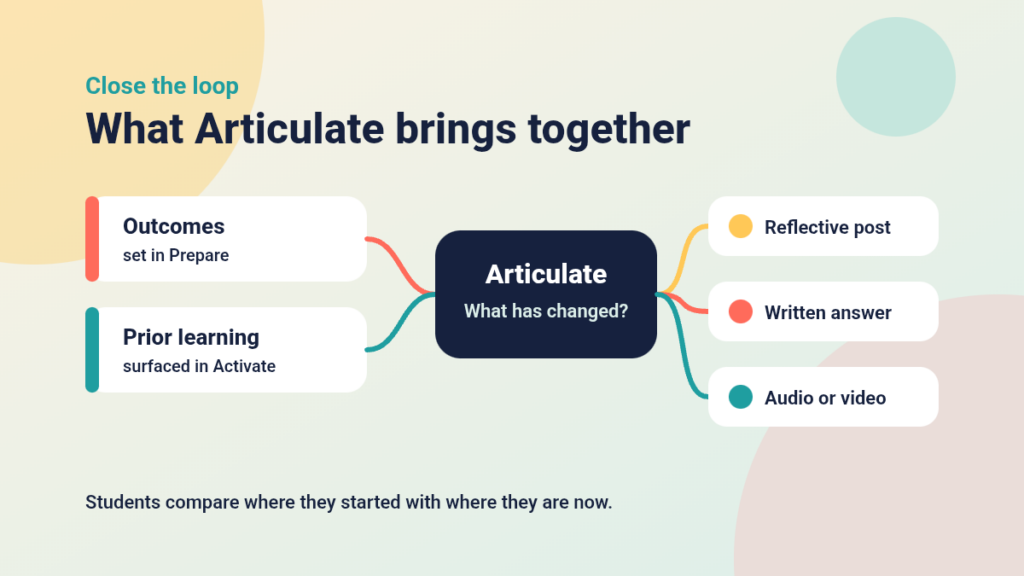
The outcomes matter just as much. They were introduced in Prepare, and Articulate is where students can check themselves against them. This closes the loop: the week began with a promise about what students would be able to do, and it ends with them judging how far they have got.
Closing the loop in PANDA
PANDA gives you the pieces already. Prepare states the outcomes. Activate draws out what students already know or think. Articulate then asks students to bring the two together.
Prompts that work
Specific prompts produce better reflection than a general request to reflect on the week. Here are some starting points, grouped by purpose.
Look back
- What did you already know about this topic at the start of the week?
- What would you say differently now?
Look at the outcomes
- Which outcome do you feel most confident about, and what is your evidence?
- Which outcome needs more work, and what might help?
Look forward
- What question do you still have?
- How might you use this learning in your next task or assessment?
A worked example
Imagine a week on research ethics. In Prepare, students read an outcome about identifying ethical risks in a study design. In Activate, a quick poll asks what they already understand about consent. In Articulate, the prompt asks how they thought about consent at the start of the week, what they would add now and which outcome they feel least sure about. Students post a short response, and you reply to the whole group with the common themes and one or two points to revisit.
Choosing a format in Canvas
Canvas offers several ways to collect students’ thinking, and the best choice depends on your group and your workload.
- Discussions let students share reflections and respond to one another. You can ask students to post before they can see replies, so that they think for themselves first.
- Assignments can accept text entries or media recordings, which suits students who find speaking easier than writing.
- Quizzes can include short-answer or essay questions for a private, lower-effort reflection.
- Peer review can add a social layer by asking students to comment on each other’s responses.
Keeping the marking load manageable
Reflection does not need detailed marking to be valuable. Consider treating it as complete or incomplete, which Canvas supports as a grade display option, or leaving it ungraded. Read a sample of responses and post a short announcement to the whole group that picks up common themes and misconceptions. Students receive useful feedback, and you avoid writing dozens of individual comments.
Common mistakes to avoid
- Asking a vague question such as “reflect on your week” that invites generic answers.
- Failing to refer back to the outcomes from Prepare.
- Setting a task that is heavier than the learning it supports.
- Never responding, which can make students feel the work was pointless.
Getting started
Choose one prompt that links outcomes with prior learning and use it every week, so that students become comfortable with it. Over time, you will see how their understanding develops, and the same prompts will give you evidence to improve the next iteration of the module.
Keep going

One Page vs Pre-In-Post vs PANDA: Choosing a Structure for Your Canvas Week
A one-page week, Pre-In-Post and PANDA each shape how students meet your content. This post compares their strengths and limits and shows how to choose and move between them in Canvas.
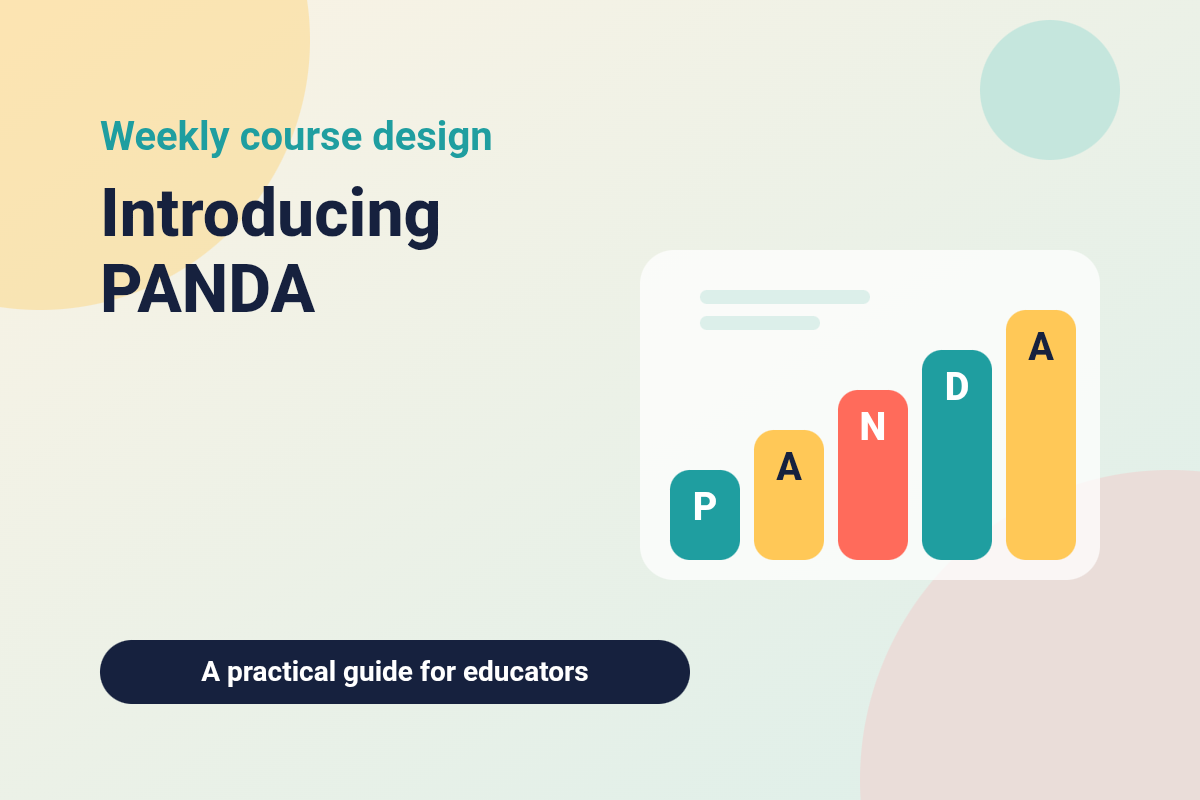
Introduction to the PANDA Framework
PANDA gives every week of an online course the same five-part structure: Prepare, Activate, Navigate, Demonstrate and Articulate. Here is how it works and how to build it in Canvas.

How to Activate Prior Learning Using PANDA
Activate is the PANDA element that gets students thinking before they meet new content. Here are three quick ways to bring prior learning to the surface in Canvas.