
In the PANDA framework (Prepare, Activate, Navigate, Demonstrate, Articulate), Activate is the second element of each week. Prepare tells students what is coming. Activate gets them thinking about it before they meet any new content. Done well, it brings what they already know to the surface, so that the rest of the week has something to build on.
What Activate is for
Activate is not where you teach new material. It is a short, low-pressure moment that wakes up relevant knowledge, experience and opinions. Students might recall a concept from an earlier module, make a prediction about what is coming or realise that they are less sure than they thought. All of these are useful starting points.
Why prior learning matters
A widely held view in education is that new learning builds on what students already know. If that foundation is shaky, new content can be difficult to absorb. If it contains misconceptions, the new material may be fitted around them without anyone noticing. Activating prior learning gives students a chance to retrieve what they know, and it gives you an early view of where the group stands.
Students also arrive with different backgrounds. Some have studied related topics, others have relevant work or life experience, and some are meeting the subject for the first time. Inviting all of these into Activate values what each person brings and helps everyone see that they have something to contribute. It also shows you where extra support may be needed.
Three ways to activate prior learning
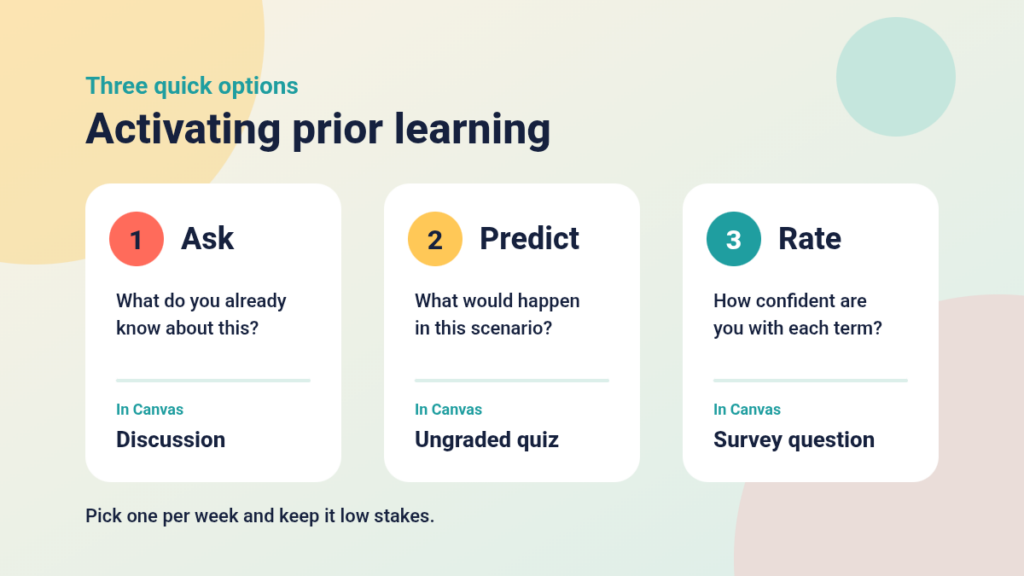
You do not need a complicated activity. The diagram below shows three quick options and the Canvas tool that suits each.
1. Ask what students already know
A simple open question works well, such as “What do you already know about this topic?” In a Canvas discussion you can require students to post before they can see replies. That way they draw on their own knowledge first, and their answers are not shaped by what others have written.
2. Ask them to predict
Present a short scenario or problem and ask what they think will happen or how they would approach it. Predictions do not need to be correct. The point is to engage students with the topic and to create a reason to find out the answer. An ungraded quiz question is a quick way to collect these responses.
3. Ask them to rate their confidence
A short self-assessment lets students judge their own familiarity with key terms or skills. In a quiz or survey you can offer options such as “new to me”, “need a recap” and “confident”. The results show you which areas need more time and which can move faster.
Building Activate in Canvas
- Keep it short. Five to ten minutes of student effort is plenty.
- Place it after Prepare. Position it second in the module so that the order matches the PANDA sequence.
- Name it consistently. A label such as “Activate: Week 3” helps students recognise the element every week.
- Make it low stakes. Ungraded or participation-only tasks encourage honest answers.
- Use interactive tools if you have them. If your institution provides H5P, a quick interactive activity can work well here.
A worked example
Suppose the week covers data visualisation. In Prepare, students read that they will learn to choose an appropriate chart type. In Activate, you show two charts of the same data and ask which is easier to read and why. Students post short answers, and the discussion surfaces ideas about clarity and audience that you can build on in Navigate.
Using what you learn
Activate is only worth doing if you look at the responses. Skim them quickly and note any common gaps or misconceptions. Then adjust the week, perhaps by adding a recap to Navigate, addressing a misunderstanding in an announcement or devoting seminar time to a stubborn idea. If you can, say what you noticed, so that students can see their contribution mattered.
Common mistakes to avoid
- Turning Activate into a graded test that makes students anxious.
- Asking questions that can only be answered by someone who has already seen the new content.
- Setting a task that takes longer than the content it introduces.
- Collecting responses and never using them.
Getting started
Choose one of the three approaches and try it for a single week. Once you see how students respond, you can adapt it for the rest of the module and build a routine that makes prior learning visible from the start.
Keep going

One Page vs Pre-In-Post vs PANDA: Choosing a Structure for Your Canvas Week
A one-page week, Pre-In-Post and PANDA each shape how students meet your content. This post compares their strengths and limits and shows how to choose and move between them in Canvas.

Introduction to the PANDA Framework
PANDA gives every week of an online course the same five-part structure: Prepare, Activate, Navigate, Demonstrate and Articulate. Here is how it works and how to build it in Canvas.

Prepare: The Important First Step in the PANDA Framework
Prepare sets the scene for each week of an online course. Here is what to include, how to build it in Canvas and how to keep it short enough that students actually read it.