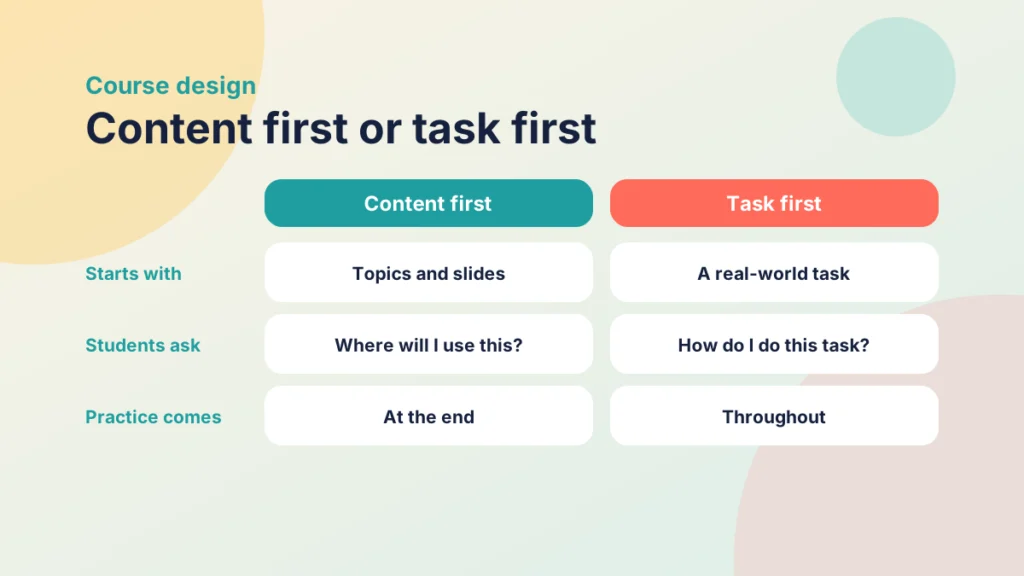
Many courses start with content and hope students will find a use for it later. Merrill’s approach reverses that: begin with a task students will meet in their work, then teach what they need to complete it. This post walks through the five principles in the order you would use them when designing a module, and it pairs naturally with the PANDA framework.
Learning outcomes
By the end of this post you’ll be able to
- Explain why task-centred learning starts with a real-world problem.
- Design a module sequence that moves through activation, demonstration, application and integration.
- Apply the sequence to a Canvas module.
Start with the task
Merrill’s first principle is that learning is promoted when learners tackle real-world problems, ideally ones they meet in daily life or work. The task comes first because it gives everything else a purpose.
Choose a task that a graduate or practitioner would recognise, such as writing a status report or planning a lesson. Show students the finished task up front, then build towards it.
Activate what students already know
Students bring experience, some of it incomplete. Activation connects new information to what they already know, and shows you where the gaps are.
Keep it low stakes: an ungraded quiz, a short discussion prompt or a quick reflection on a similar situation they have faced.
Put it into practice
Your turn
Write three questions that reveal what students already know about your next topic. Decide whether to ask them in an ungraded quiz or a discussion.
Show the skill, do not only describe it
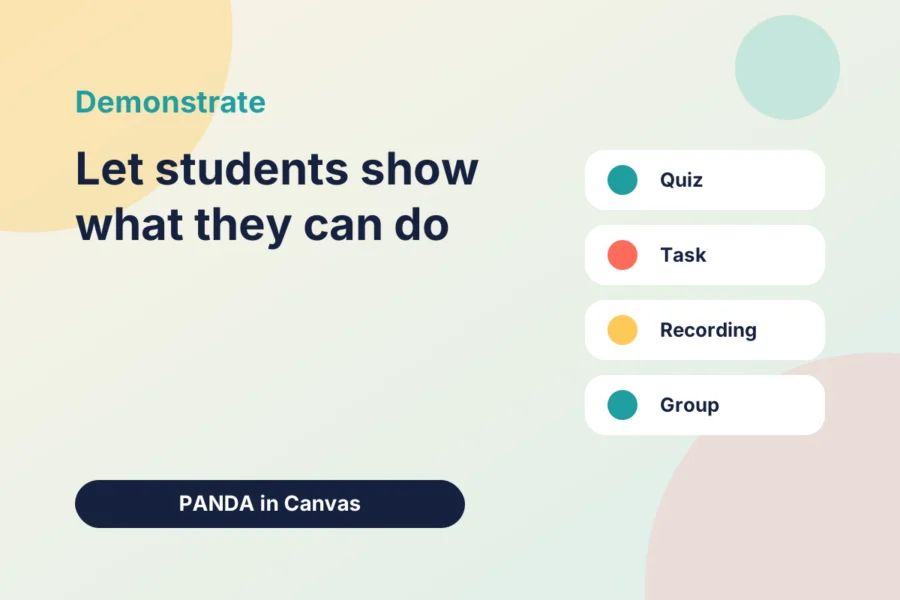
Demonstration means showing students how the task is solved, not only telling them. A worked example lets them see the decisions behind each step, and a short recorded walkthrough works online.
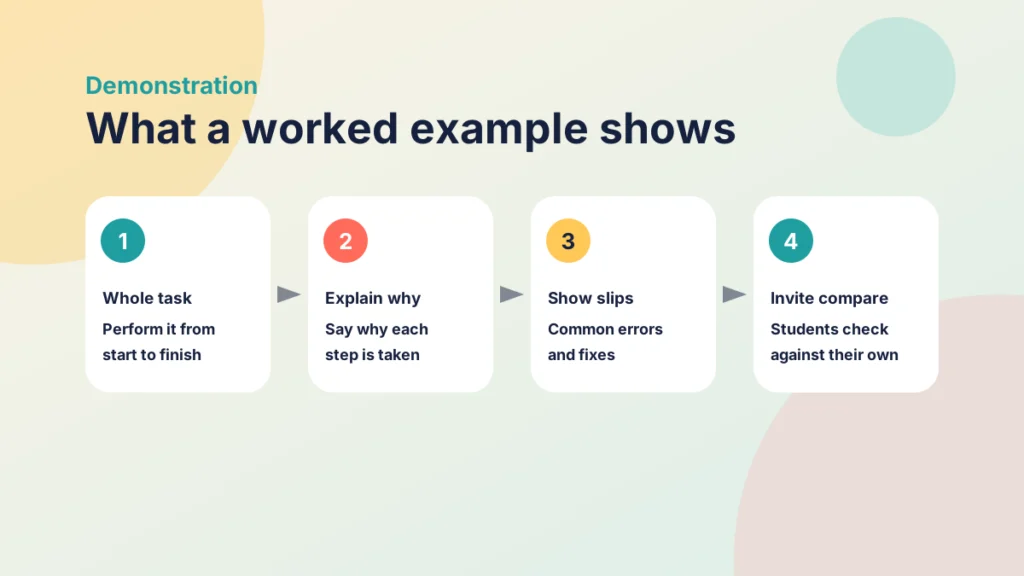
Show the whole task first, explain why each step is taken, and point out common slips and how to fix them.
Practise with feedback
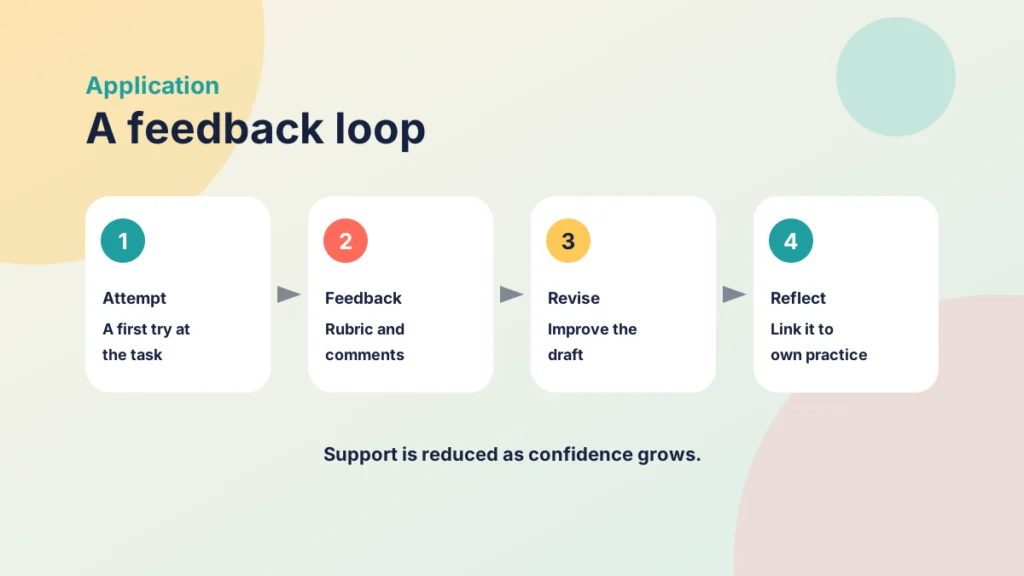
Application is where students try the skill and receive feedback. Early attempts should be supported, with help reducing as confidence grows. A clear rubric tells students what a competent attempt looks like, and 5 tips for building effective rubrics in Canvas explains how to build one.
Put it into practice
Your turn
Draft one rubric criterion that describes a competent first attempt at your task.
Take it into professional practice
Integration asks students to adapt the skill to their actual professional life. A reflective discussion or a short plan for using the approach at work helps learning transfer.
Case study
Rebuilding a reporting module around one task
Illustrative example
The context
A tutor teaches a part-time professional module at a UK university.
The challenge
Content-first sessions went well, but students struggled to use the ideas in their final report.
What they did
The tutor opened with one task: write a short status report for a manager. An ungraded quiz and a discussion surfaced past experience. A recorded worked example followed, then a draft with rubric feedback, then a reflection on using the approach at work.
What happened
Students could see the point of each week, and their drafts drew on their own workplaces. The tutor spent less time answering questions about what the assessment wanted.
What would you do?
- What single task could anchor one of your modules?
- Which of the four later phases is thinnest in your current design?
Bringing it together in Canvas
A Canvas module can follow this sequence from top to bottom. If you are choosing between building with Modules or Pages, Driving Canvas: Modules vs Pages explains why Modules usually suit this approach, and Connecting PANDA with Gagné and Bloom’s Taxonomy shows how the models relate.
Put it into practice
Try it in Canvas
- Open Modules and add a module named after the task.
- Add a Page that sets out the task and what students will be able to do.
- Add a Quiz and set the Quiz Type to Practice Quiz, so activation is ungraded.
- Add a Page with your recorded worked example, using the Rich Content Editor to embed the video.
- Create an Assignment and attach a rubric through Add Rubric.
- Add a Discussion for reflection, then use Add Requirement on the module so items unlock in order.
Try it yourself
What would you do?
You are redesigning a module around a real task. Choose the best option at each decision point, then read the feedback.
Check your understanding
Knowledge check
Why does a task-centred design start with a real-world problem?
It gives every later activity a purpose.
Give one way to activate prior knowledge without grading it.
An ungraded quiz or a discussion prompt about past experience, because it surfaces what students already know.
What makes a worked example stronger than a list of steps?
It shows the task being performed with the reasoning explained, so students see how the steps connect.
Which phase asks students to adapt the skill to their own workplace?
Integration, because it moves learning from the course into professional practice.
Remember
Key takeaways
- Start with a real-world task that gives the module a purpose.
- Activate prior knowledge with low-stakes questions before teaching.
- Demonstrate with worked examples that show the reasoning.
- Give students practice with rubric-based feedback.
- Finish by helping them adapt the skill to their own practice.
Your next step
This week, pick one module and write the real-world task it should prepare students for. Put it at the top of the module as a Page, then check that each later item serves it. Look for any item with no clear link to the task.
Reflect: if a student finished your module tomorrow, what could they do that they could not do before?