Plenty of frameworks describe what good instruction looks like. Merrill’s First Principles of Instruction are useful because they are short enough to remember and practical enough to apply to a course you are building this week. This post introduces the five principles and shows how they translate into a Canvas module.
If you already use PANDA, you will find the two fit together well. I introduce PANDA in my introduction to the PANDA framework, and compare it with other models in Connecting PANDA with Gagné and Bloom’s Taxonomy.
What are Merrill’s First Principles?
In a 2002 article, M. David Merrill reviewed a range of instructional design theories and drew out the ideas they had in common. His proposal was that learning is promoted when five principles are present, and weakened when they are missing.
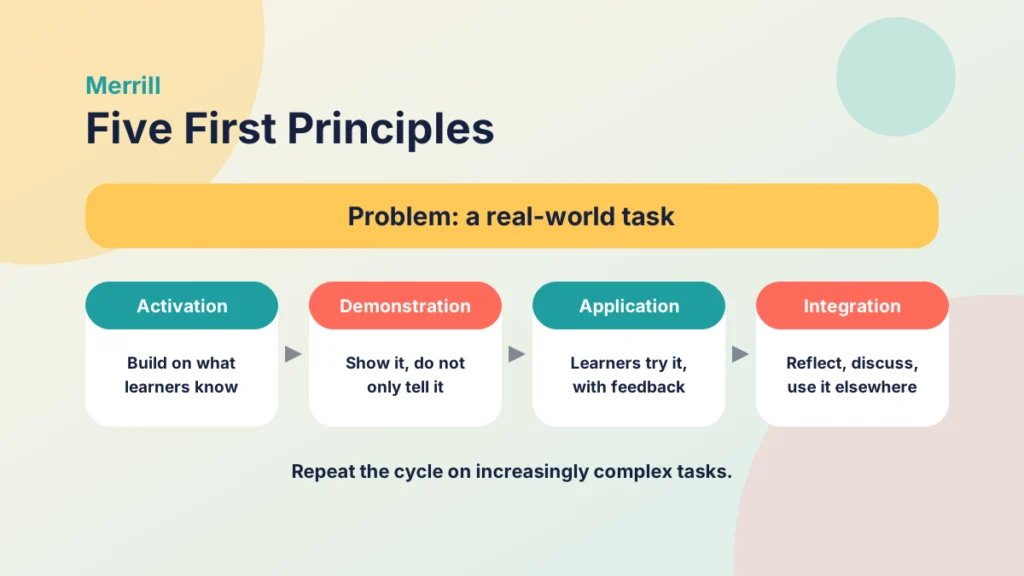
The principles are built around a real-world problem. Learners work through increasingly complex tasks, and each task moves through four phases: activation, demonstration, application and integration.
The five principles
Problem: start with a real task
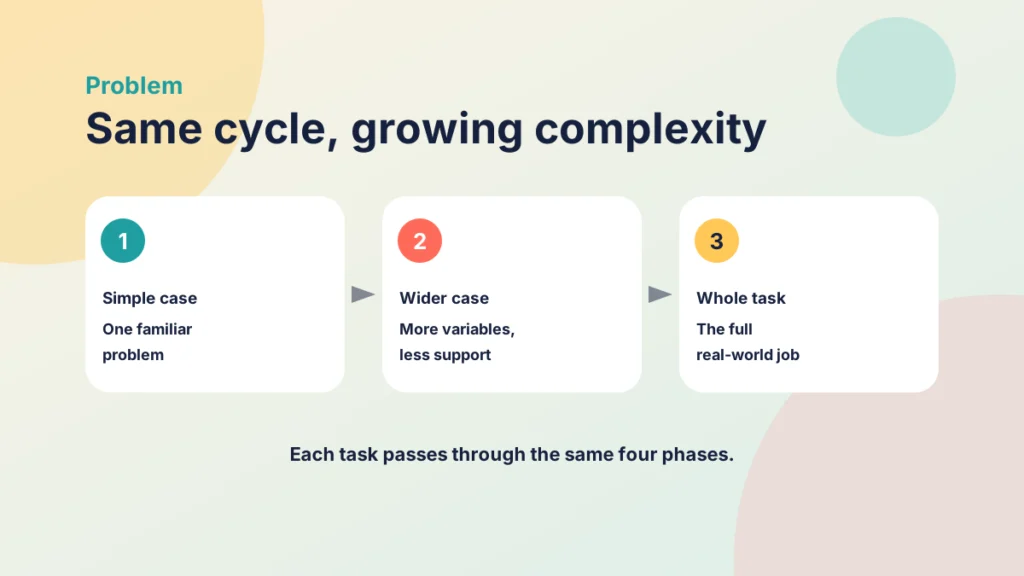
Learning is promoted when learners tackle real-world problems. Open a module with a realistic task, such as a case a graduate might face, and show students what they will be able to do by the end. Start with a simple version of the task, then build towards the whole thing.
Activation: build on what they know
Learning is promoted when existing knowledge is activated as a foundation for new knowledge. An ungraded quiz, a short discussion prompt or a quick reflection on prior experience all work. The aim is to surface what students already know, including the gaps.
Demonstration: show it, not just tell it
Learning is promoted when the new skill is demonstrated, not only described. Worked examples, annotated models and short walkthrough videos fit here. Let students see the steps rather than just the finished result, and show common errors alongside good practice.
Application: let them try it, with feedback
Learning is promoted when learners apply new knowledge and receive feedback. Early practice should be supported, with help reducing as confidence grows. A clear rubric keeps feedback consistent, and 5 tips for building effective rubrics in Canvas covers how to set one up.
Integration: take it into their own world
Learning is promoted when learners take new knowledge into their own world, by reflecting, discussing, defending it or creating something of their own. In an online course, a reflective discussion or a short portfolio entry gives this phase a home.
Put it into practice
Your turn
Pick one module you teach and write a single sentence naming the real-world problem it prepares students to solve. If you cannot write it, note which topic could anchor the module.
Using the principles in Canvas
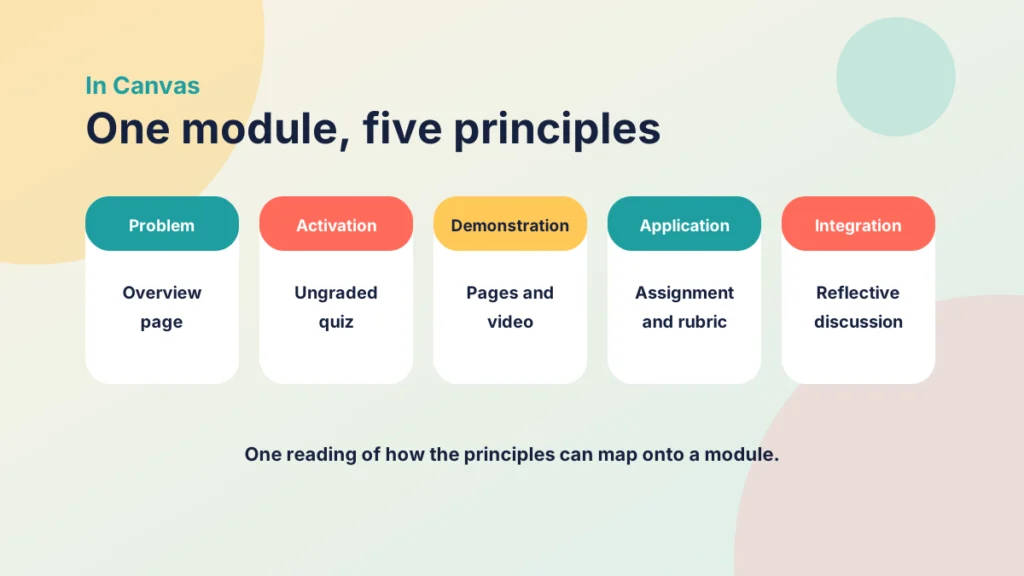
This is my reading rather than an official mapping, but the five principles line up neatly with how a Canvas module is built. An overview page sets the problem. An ungraded quiz activates prior knowledge. Pages and short videos carry the demonstration. An assignment with a rubric gives application with feedback, and a reflective discussion closes the cycle with integration.
The same sequence maps onto the five PANDA elements, which is why the two work well together. If you like comparing models, five practical tips for using Gagné’s nine events shows another way to sequence a Canvas course.
Put it into practice
Your turn
Open one of your Canvas modules and list its items in order. Beside each, write the Merrill principle it serves. Look for a missing principle, most often activation or integration, and plan one small item to fill the gap.
Try it yourself
Which principle is it?
Read each course activity and choose the Merrill principle it mainly serves. This is my reading, and some activities could serve more than one.
Check your understanding
Knowledge check
What do Merrill’s principles centre on, and why does that matter?
A real-world problem. It gives activation, demonstration, application and integration a purpose.
Name one Canvas item that supports activation.
An ungraded quiz or a short discussion prompt, because it surfaces what students already know.
How does demonstration differ from simply presenting content?
It shows the skill being performed, for example with a worked example, rather than only describing it.
Students finish a module but never use the idea in their own practice. Which principle is weak?
Integration. Reflection, discussion or creating something of their own helps learning transfer.
Remember
Key takeaways
- Merrill’s five principles are problem, activation, demonstration, application and integration.
- Everything is built around a real-world task, which gives each phase a purpose.
- Demonstration shows the skill being performed, rather than only describing it.
- Application needs feedback, and a rubric helps keep it consistent.
- A Canvas module can follow the same sequence, from overview page to reflective discussion.
Your next step
This week, pick one module and add the principle it is missing: perhaps a short ungraded quiz at the start (activation) or a reflection prompt at the end (integration). Afterwards, look at how students respond and whether their later work refers back to the new item.
Reflect: which of the five principles do your students currently get the least of, and what would it take to add it?