You build a clear Canvas module, publish it, and watch the page views thin out after the second week. It is rarely a motivation problem in the students. More often the course has not given them enough reasons to start, ways to take part, or a sense of where they are heading.
The Engagement Cycle gives you three stages to check: Motivation, Participation and Progression. Each stage feeds the next, and progress feeds motivation again. The model comes from an infographic called Student Engagement is Cyclical, from Canvas Certified Educator material. I have explained it in my own words and added practical advice for each of its nine strategies. This post continues my engagement series, following the tips on using Gagné’s Nine Events of Instruction in Canvas and the ideas for effective icebreakers.
Learning outcomes
By the end of this post you’ll be able to
- Explain how Motivation, Participation and Progression feed one another
- Identify the weakest stage in one week of your own course
- Apply one strategy from each stage using tools you already have in Canvas
- Design a short weekly loop for a blended course
What the Engagement Cycle is
Engagement is not a trait that students either bring with them or lack. It is a response to what a course asks of them, which means you can design for it.
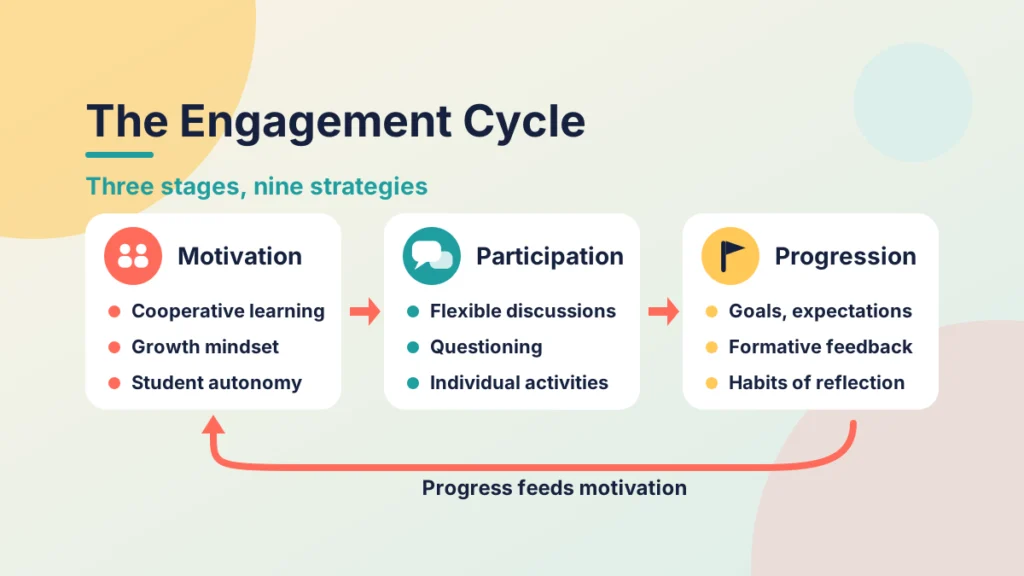
The cycle has three stages, and each has three strategies:
- Motivation: students want to learn and grow. The strategies are cooperative and social learning, growth mindset and student autonomy.
- Participation: every student gets actively involved. The strategies are flexible discussions, questioning and individualised activities.
- Progression: students can see how far they have come and what comes next. The strategies are goals and expectations, formative feedback and habits of reflection.
Two ideas sit underneath the model. First, even students who lack strong motivation can be supported to engage, so motivation is something you can build rather than wait for. Second, when participation is framed as progress towards clear, relevant goals, students gain a sense of control, and that strengthens motivation again.
Why a cycle rather than a checklist
Most course design advice reads as a list of things to include. A cycle asks what happens between the stages. Students rarely drop away in the middle of an activity. They drop away in the gaps, when they do the work and see no sign that it mattered, or finish the week with no sense of progress.
The Engagement Cycle wheel
Choose a stage on the wheel, then open each of its strategies. Look at every stage to complete the wheel.
You have visited all three stages. Notice how progress feeds motivation, which is why the stages form a loop and not a list.
Motivation: give students reasons to start and keep going
You cannot hand motivation to students, but you can create conditions in which it grows. Three strategies help.
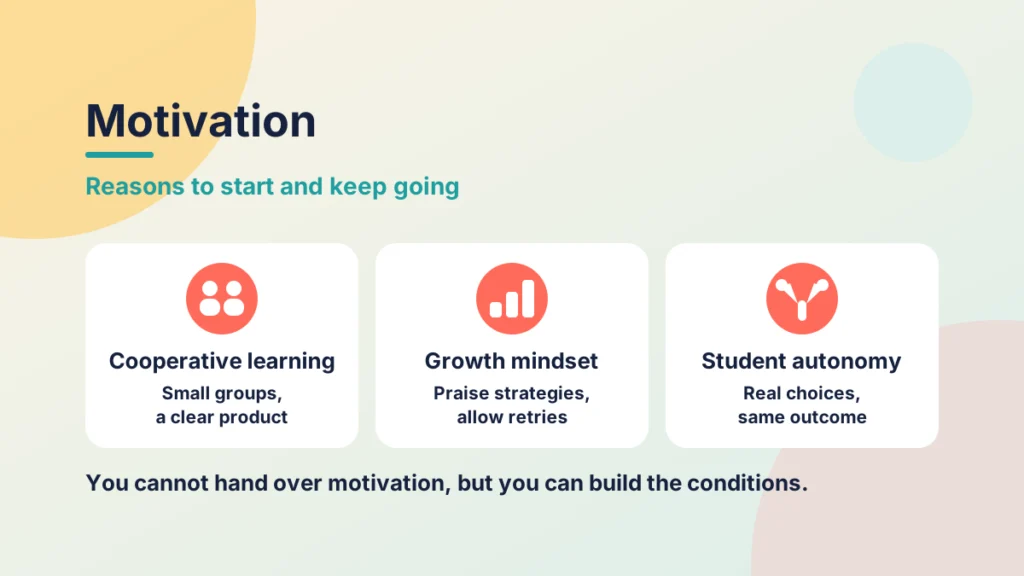
Cooperative and social learning
People learn from one another, and belonging makes it easier to turn up. Students on a blended course can feel isolated online, so connection needs designing in.
- Use small groups of three or four, each with a defined task.
- Start with a low-risk activity so that students meet before they have to disagree.
- Ask each group to produce something, such as a shared answer in a Canvas group space.
- Rotate the groups so that quieter students are not stuck in the same one all term.
Group work without a clear task turns into a chat. Give every group a product.
Growth mindset
A growth mindset is the belief that ability develops through effort and good strategies. The evidence for formal mindset programmes is mixed, so the practical value lies in how you design tasks and word comments, not in slogans.
- Praise the strategy, for example “you checked your units before submitting”, rather than talent.
- Allow retries on practice quizzes, so that a first attempt is not a final judgement.
- Show a worked example that contains a mistake, and fix it in front of students.
- Use “not yet” language in feedback, and say what the next step is.
Student autonomy
Autonomy means students have a real say in how they learn. Small choices add up.
- Offer a choice of topic or format for one activity, with every option meeting the same outcome.
- Explain why a task matters before students start it.
- Add an optional extension for students who want to go further.
Keep the choices real. If one option is clearly easier, students will notice.
Put it into practice
Your turn
Pick one activity in next week’s module and offer two routes to the same outcome. Write each route in a single sentence, and check that both would show you the same learning.
Participation: get every student involved
Participation that involves every student, not just the confident few, tends to lead to stronger, deeper learning. The test I use is simple: could a student complete this just by scrolling? If so, it is observation, not participation.
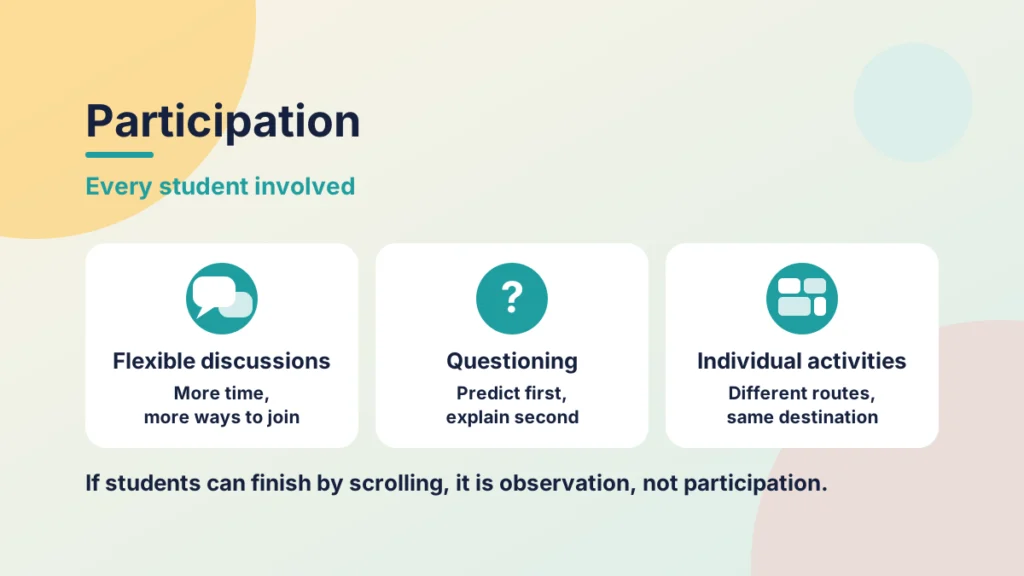
Flexible discussions
One discussion format suits some students and shuts out others. Flexibility means more ways, and more time, to contribute.
- Keep discussions open for a few days so that students who need time to think can join.
- Allow different formats, such as a written post or a short recorded reply, where your institution has the option switched on.
- Ask a specific question. “Post one example from your own experience and say which principle it shows” works better than “Discuss this”.
- Reply to a few posts yourself, or summarise the thread, so that contributions feel noticed.
Questioning
Good questions make thinking visible. Ask before you explain: a prediction costs students almost nothing to give, and it makes the explanation that follows matter.
- Open a module with a one-question ungraded survey that asks for a prediction.
- Ask “why” and “what would happen if” more often than questions of pure recall.
- Attach a short explanation to each answer in a Canvas quiz, so that questions teach as well as test.
- Invite students to write a question of their own for the group.
Individualised activities
Students do not all start in the same place. Individualised activities let the route vary while the destination stays the same.
- Offer a starter and a stretch version of the same task.
- Let students apply a concept to their own context, such as a placement, workshop project or workplace.
- If Mastery Paths is switched on in your Canvas, use it to release extra practice to students who need it.
Progression: show students where they are heading
Students stay engaged when they can see progress towards goals that matter. This is the stage where participation turns back into motivation, so skipping it weakens the whole cycle.
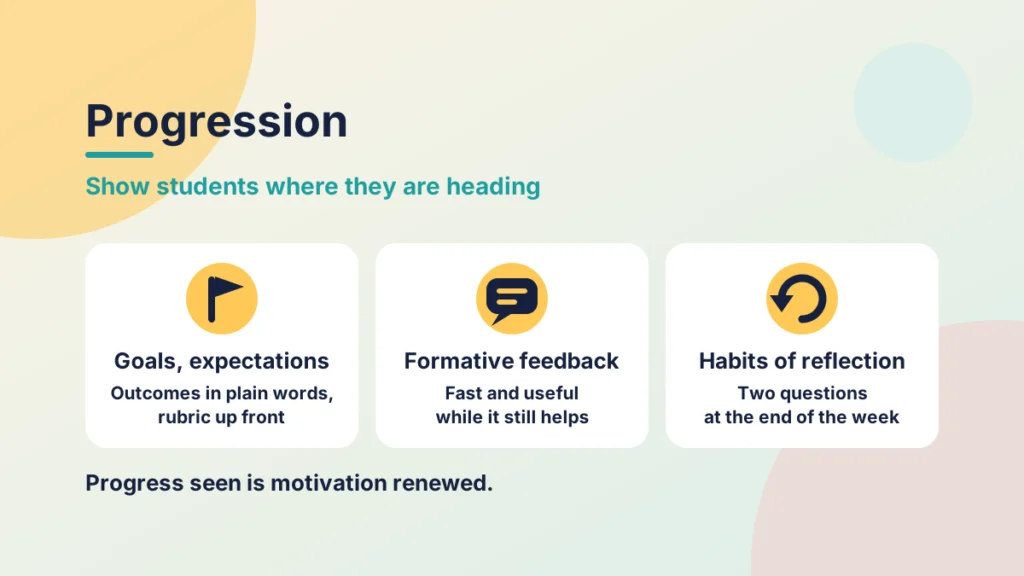
Goals and expectations
Students cannot aim for what they cannot see.
- State the outcome in plain words at the top of each module.
- Show what good looks like with a short annotated example.
- Attach a rubric to the assignment so that students see the criteria before they start. My tips for building effective rubrics in Canvas show how.
- Give dates and a rough time estimate for each task.
Formative feedback
Formative feedback helps students improve while there is still time to act on it. Fast and useful beats slow and detailed.
- Use automatic feedback on quiz answers.
- Release a model answer after submission, so students can compare it with their own.
- Post a short whole-group summary of what went well and what most people missed. Ten minutes on this often does more than twenty minutes of individual comments.
- Aim to respond within a day or two for a weekly task.
For individual comments that students will actually use, see creating meaningful feedback.
Habits of reflection
Reflection turns activity into learning, and it points students to what comes next.
- End each week with two questions: what did I learn, and what is still unclear?
- Collect the answers in a low-stakes Canvas survey or journal, and read a handful.
- Open the following week with a short recall question about this one.
- Ask students to set one small goal for the coming week, which feeds straight back into motivation.
Sort the strategies
Nine strategies, three stages. Read each one and choose the stage it belongs to.
Using the cycle in your Canvas course
You do not need to redesign a course to use the cycle. Start by auditing one week.
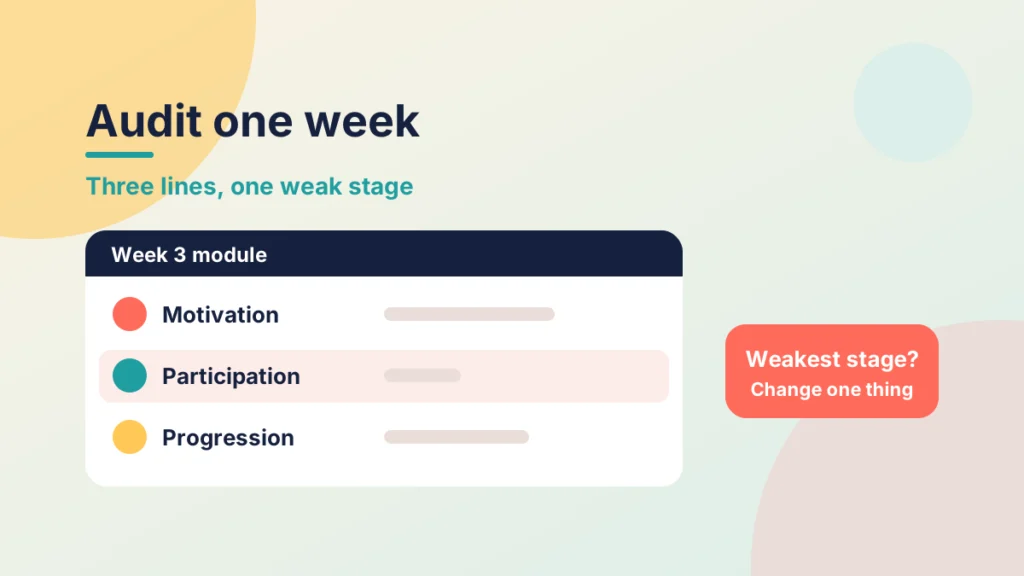
Audit your week
Think of one week of your own course. Answer the three questions honestly, and you will see which stage to improve first.
- Map it. Write one line each for Motivation, Participation and Progression in that week.
- Find the gap. Notice which line was hardest to write. That is usually your weakest stage.
- Change one thing. Improve one strategy in that stage, and leave the rest alone.
- Look at the evidence. After a week, check the submission and participation data in Canvas and read a few student responses.
Keep the audit honest by looking at the week as a student would, from the module page rather than the editing view. Change only one stage at a time, so that you know which change made a difference. If your modules already follow a structure such as PANDA, the cycle fits neatly. My introduction to the PANDA framework shows how the pieces fit together.
Case study
A blended engineering course that goes quiet online
From practice
The context
A Further Education lecturer in mechanical engineering teaches a blended learning course, where part of the learning happens online in Canvas.
The challenge
He is struggling with student engagement. It is hard to tell whether the gap lies in why students start, how they take part or whether they can see progress, which is exactly where a simple diagnostic helps.
What they did
He is applying the cycle one stage at a time rather than rebuilding the course. The first step is to map a single week against Motivation, Participation and Progression. Then he changes one strategy in the weakest stage. For an engineering topic, that might mean opening with a prediction question about a real mechanism, or posting a quick whole-group summary after an online task.
What happened
This one is still in progress, so there is no result to report yet. The signs worth watching are whether more students attempt the online task before they meet, whether their answers show more thought, and whether they return to the following week’s page without a reminder.
What would you do?
- Which stage of the cycle would you check first in your own blended course, and why?
- What would a student on your course do if nobody responded to their work for a week?
Put it into practice
Your turn
On a sheet of paper, write Motivation, Participation and Progression as three headings. Fill them in for the week you are teaching now, using one short line each. Circle the line you found hardest to write, and choose one strategy from this post to try before the week ends.
What would you do?
A Further Education lecturer in mechanical engineering wants more students to engage with the online part of a blended course. Help him decide at three points, one for each stage of the cycle.
Check your understanding
Knowledge check
Name the three stages of the cycle in order, and explain how the last one connects to the first.
Motivation, Participation and Progression. Seeing progress towards clear goals strengthens motivation, which is what turns the stages into a cycle.
A page asks students to read a chapter and “think about” torque. Which stage is weak, and how would you strengthen it?
Participation. Ask a question that makes students produce something, such as a prediction, so that they cannot complete it by scrolling.
A quiz has just closed and you have ten minutes. Which response is likely to reach the most students?
A short whole-group summary of strengths and common misconceptions, because every student sees their work feed into something.
Describe two ways to build habits of reflection in a Canvas week.
For example, end the week with a two-question survey, open the next week with a recall question, or ask students to set one small goal.
Remember
Key takeaways
- The cycle has three stages, Motivation, Participation and Progression, each with three strategies.
- Students tend to drop away in the gaps between stages, not within them.
- Participation means doing something that cannot be completed by scrolling.
- Fast, useful feedback often beats slow, detailed comments.
- Clear goals and reflection feed progress back into motivation.
Your next step
This week, pick one module and write one line for each stage. Choose the weakest stage and try one strategy from it, such as a prediction question or a short whole-group feedback summary. Afterwards, compare how many students took part with a similar task earlier in the course, and read a handful of answers for signs of thought.
Reflect: Where in your course do students do the work and then hear nothing back?
Keep going
Bad Practice in Canvas and How to Fix It
The most common bad practice in Canvas, from file dumps to stale dates, and a practical fix for each one.

What Is SAMR and How to Use It in Canvas
SAMR is a model for judging what technology really changes in teaching. See the four levels and how to use them to improve a Canvas course.

Refreshing Old Canvas Pages Without Rebuilding Them: A Before-and-After Checklist
You can improve inherited Canvas pages one at a time. This post gives you a short checklist for headings, link text, images and consistency, with a worked before-and-after page.