A comment can be accurate, kind and thorough, and still change nothing. Students read the mark, glance at the words and move on. Meaningful feedback is feedback a student can act on before the next task. This post gives you a simple way to write it and a way to keep it manageable in Canvas.
Learning outcomes
By the end of this post you’ll be able to
- Explain what separates usable feedback from a general remark.
- Rewrite a vague comment so that it names a strength, a gap and a next step.
- Plan when and where students will receive feedback in a Canvas course.
What makes feedback meaningful
Think of feedback as information that closes a gap. It tells a student where they are, where they are heading and what to do next. If one of those three is missing, the comment is hard to use.
Three habits make the difference. Meaningful feedback is specific, so it points at something in the work. It is forward-looking, so it says what to do next time. It is timely, so the student can still use it. A mark on its own meets none of these.
It also helps to start from the outcome rather than the script. If your rubric describes what good work looks like, your comments can borrow its language. 5 Tips for Building Effective Rubrics in Canvas covers how to write criteria that make this easy.
Write comments a student can use
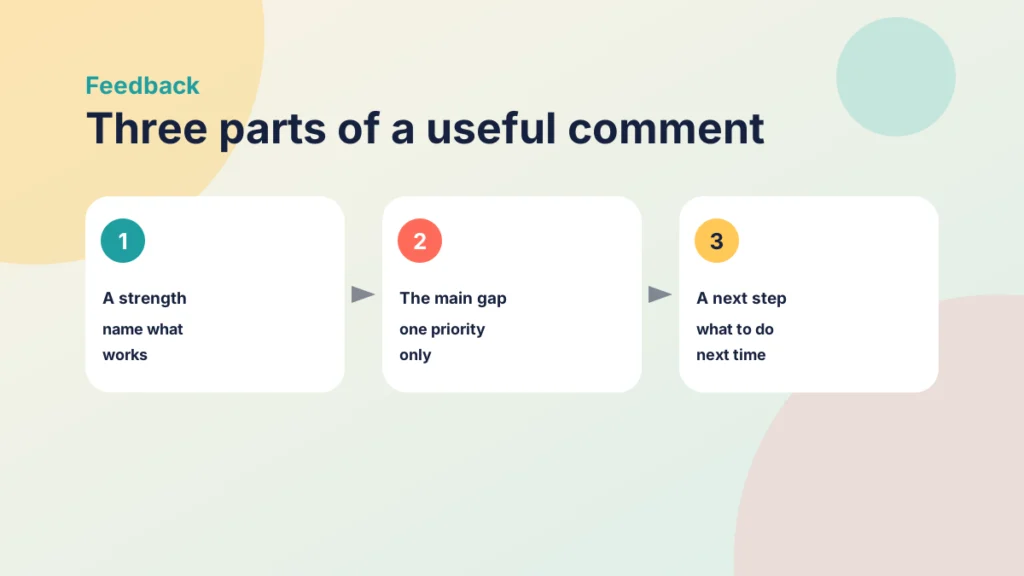
A reliable pattern has three parts: name one thing that works, name the one gap that matters most, and give a next step. Keep it to one priority.
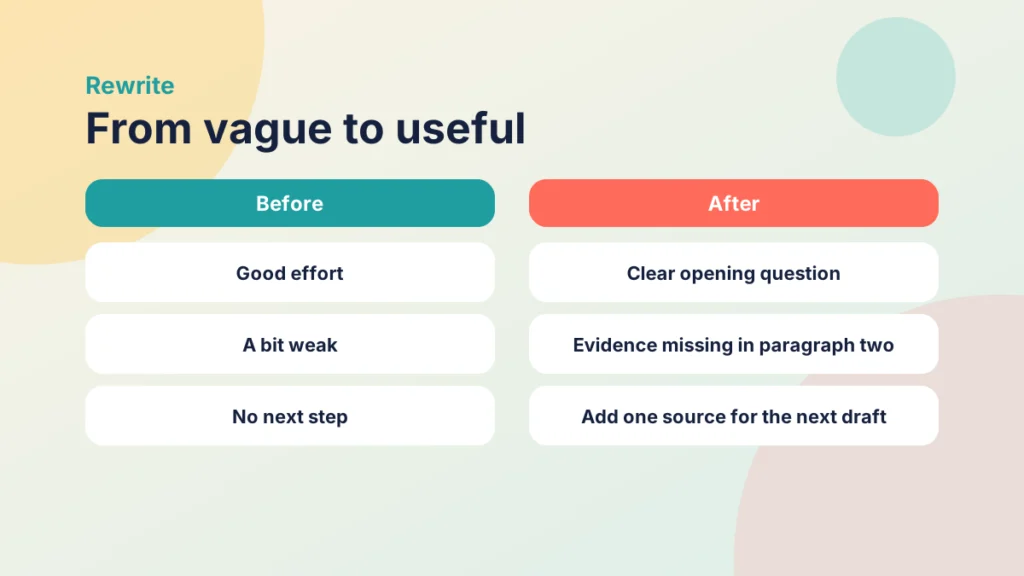
Before: Good effort, but your argument is a bit weak.
After: Your opening states the question clearly. In paragraph two, you say attendance drives results, but you do not show evidence yet. Add one source that supports this before your next draft.
Put it into practice
Your turn
Take one comment you gave recently. Rewrite it using the three parts. Could a student act on it without asking you what you meant?
Case study
A first-year report
Illustrative example
The context
A first-year student submits a short report for a module with several short assignments.
The challenge
The report is well organised, but the conclusion repeats the introduction rather than answering the question.
What they did
The tutor wrote one comment that praised the layout, named the conclusion as the priority, and gave a one-sentence next step for the following assignment.
What happened
The student used the same approach in the next report and asked a more focused question in the tutorial.
What would you do?
- Which part of the comment would you keep?
- What would you add if the next task came in two weeks?
Try it yourself
Which feedback is more useful?
Read each situation and choose the response a student could use best. Feedback explains why after each answer.
Time it so students can act
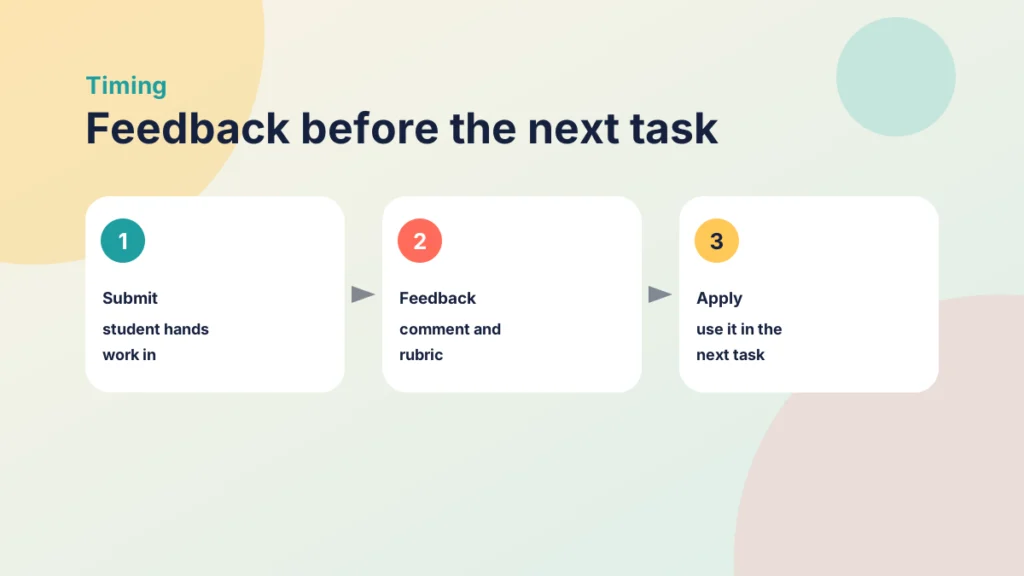
Even a perfect comment loses value if it arrives too late. Plan feedback so that it lands before a student starts the next related task, and so that the task asks them to use it.
The structure of your weeks helps. If each week includes a chance to apply what has just been learned, feedback has somewhere to go. One Page vs Pre-In-Post vs PANDA looks at how to set that up, and the Demonstrate step of the Introduction to the PANDA Framework is where students show what they can do.
Put it into practice
Try it in Canvas
- Open the assignment and select SpeedGrader.
- Use the Assessment panel to add a comment for each student, and attach the rubric if one is set.
- Select Submit to save the comment and grade for that student.
- Check Student View or Grades to see how a student will find the feedback.
If you are new to the tool, How to Use SpeedGrader in Canvas and Why walks you through it, and How to Use a Rubric in SpeedGrader shows how rubric ratings and comments work together.
Save effort without going generic
Meaningful does not have to mean slow. When many students make the same mistake, write the comment once and reuse it. Keep a small bank of next-step comments for the issues you see every term, then add one detail that belongs only to that student.
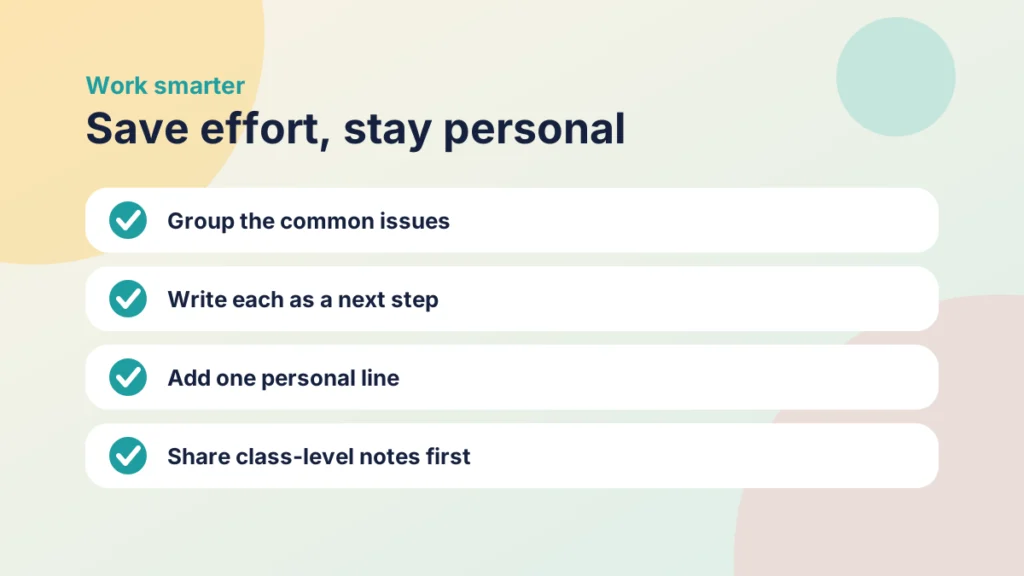
- Group the common issues. Note the three or four that appear most often.
- Write each as a next step, not a verdict.
- Add one personal line from the student’s own work.
Check your understanding
Knowledge check
What three parts make a comment easy to act on?
A strength, the main gap and a next step.
Why does timing matter for feedback?
Students can only use it if it arrives before they begin the next related task.
How can you keep comments personal when many students share an issue?
Reuse a saved next-step comment and add one detail from that student’s own work.
Remember
Key takeaways
- Meaningful feedback is specific, forward-looking and timely.
- Name a strength, the main gap and a next step.
- Plan feedback to land before the next related task.
- Reuse next-step comments and add one personal detail.
Your next step
This week, choose one assignment you are about to mark and write its comments using the three-part pattern. Afterwards, look at the next piece of work from the same students and see whether the gap you named has changed.
Reflect: what is the one piece of feedback you give most often, and how could you turn it into a next step?