
Writing the same quiz questions every year is slow, and it makes consistency hard when several tutors teach one module. An item bank gives you one organised pool of questions to reuse. This post explains what item banks are, why they help and how to build one in Canvas.
Learning outcomes
By the end of this post you’ll be able to
- Explain what an item bank is and why it helps.
- Build an item bank and draw items from it in a New Quiz.
- Design a bank that stays organised and reusable.
What is an item bank?
An item bank is a collection of quiz questions, called items, stored outside any single quiz. When you build a quiz, you draw items from the bank instead of writing questions from scratch.
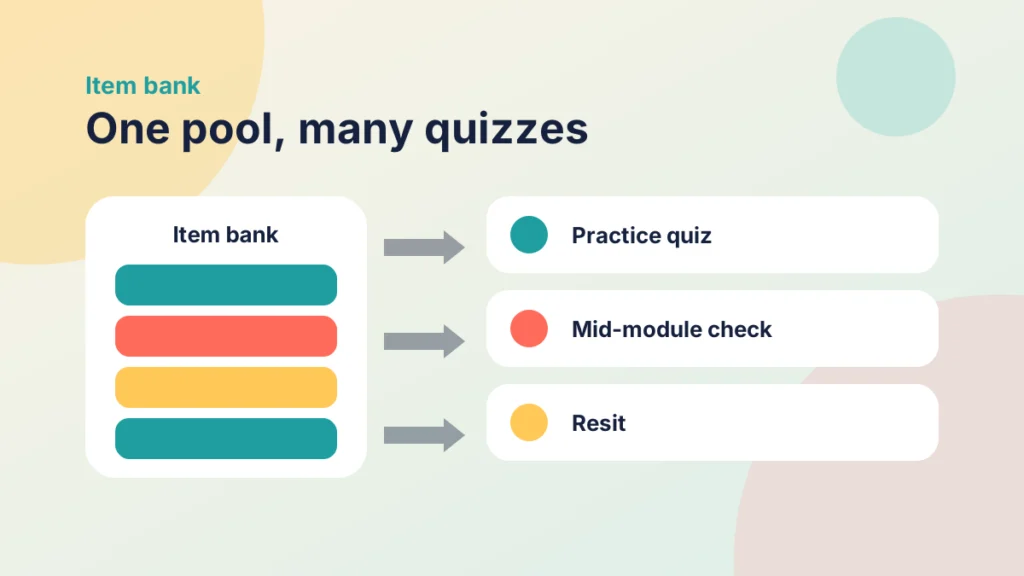
The same bank can serve a practice quiz, a mid-module check and a resit, so you write each item once.
Why build one
Item banks save time, but the stronger reasons are about quality.
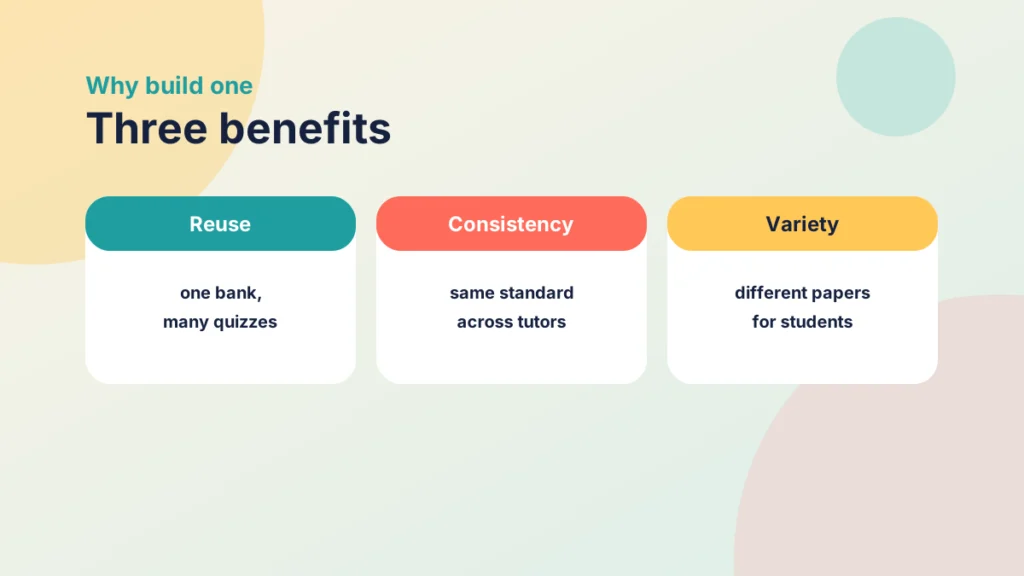
- Reuse: one bank can feed many quizzes and cohorts.
- Consistency: a team shares the same standard of question.
- Variety: drawing at random means students can receive different papers, which makes copying answers harder. For a wider view on assessment risks, see the dangers of using AI for summative assessments.
A bank is also a good place to balance recall and higher-order questions. The new Bloom’s Taxonomy guide can help you pitch each item.
Try it yourself
Draw three student papers
Change the size of the bank and the number of items drawn, then see how much the papers overlap. Keep drawing to see the pattern.
The bank has three topics: Definitions, Applying ideas and Evaluating. Each student's quiz draws at random from every topic.
How to build an item bank
Item banks work with New Quizzes. Start small, with one topic, and build outwards.
Put it into practice
Try it in Canvas
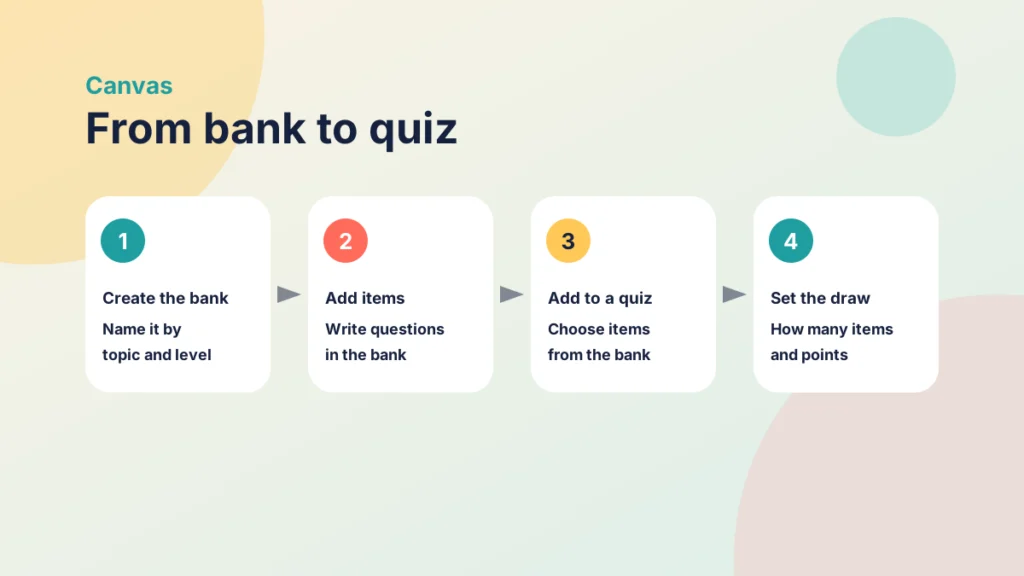
- Open Item Banks from Course Navigation (menu names can vary slightly between institutions).
- Choose to add a bank and give it a clear name, such as the topic and level.
- Open the bank and add items, using the question types you need.
- Create or open a New Quiz and, on the Build tab, add items from your bank.
- Choose how many items to draw at random, and set the points for each.
- Use the bank’s Share option to give colleagues access.
If you want to speed up writing, the Canvas Quiz Generator can draft items for you to review and add.
Keeping a bank useful
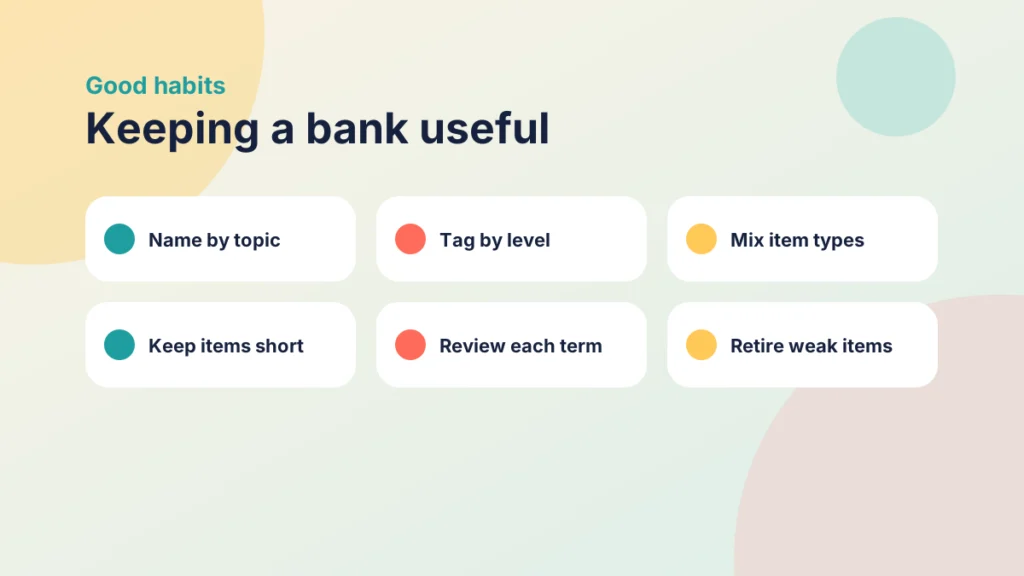
A bank only helps if you can find things in it. Name banks by topic and level, mix recall and application items, and keep each item short and unambiguous. Review items after every run, and retire ones that do not work.
Put it into practice
Your turn
Choose one quiz you reuse. List its questions and group them by topic. This is the start of your first bank.
Case study
One shared bank for a module team
Illustrative example
The context
Three tutors teach a first-year module at a UK university.
The challenge
Each tutor wrote their own quizzes, so difficulty varied and questions were rewritten every year.
What they did
They built one shared bank, named by topic, and drew a set number of items per topic for each quiz.
What happened
Quizzes felt more consistent across groups, and preparing next year’s quizzes meant reviewing the bank rather than starting again.
What would you do?
- Which of your quizzes could draw from one shared bank?
Check your understanding
Knowledge check
In your own words, what does drawing from a bank do?
It pulls items at random into a quiz, so students can receive different papers from the same pool.
Why might a bank of 12 items be a poor choice for a quiz drawing 12?
Everyone would get the same items, so the bank would add no variety.
Name two habits that keep a bank useful.
For example, naming by topic and level, and reviewing items after each run, so the bank stays organised and accurate.
Where would you share a bank so a teaching team can reuse it?
Through the bank’s Share option, so colleagues can use the same items and keep standards consistent.
Remember
Key takeaways
- An item bank is a reusable pool of questions stored outside any one quiz.
- Drawing at random lets students receive different papers.
- A bank needs to be larger than the draw to add variety.
- Clear names and regular review keep a bank useful.
- Sharing a bank helps a team keep a consistent standard.
Your next step
This week, pick one quiz you reuse and build a small bank of ten items on a single topic. Draw five into a New Quiz and preview it twice. Look at whether the two previews feel different and whether any item needs rewording.
Reflect: which questions do you rewrite every year that a bank could hold for you?