If you design courses, sooner or later you meet two names that keep appearing in instructional design reading lists: Robert Gagné and M. David Merrill. Both offer practical guidance on how to organise instruction so that people learn more effectively, and both are widely used by academics who want a principled way to plan teaching. They are often mentioned together, which makes it easy to assume they say the same thing in different words. They do not. This post compares the two, shows where they overlap and where they pull in different directions, and helps you decide how to use them when you plan a session, a module or a whole course.
Why compare Gagné and Merrill?
Both models are prescriptive. That means they do not only describe how learning happens; they recommend what a designer should do. For busy academics that is valuable, because a framework you can turn into a checklist is easier to use than a theory you must interpret. The risk is that a checklist can be applied mechanically. Comparing two frameworks is a good way to avoid that, because the points where they disagree show you which design decisions are really yours to make.
The comparison also helps when you are reviewing existing material. If a module follows one model closely, the other can act as a second opinion that highlights what is missing.
Gagné’s nine events in brief
Robert Gagné developed the nine events of instruction as part of his wider work on the conditions of learning. The idea is that learning involves internal mental processes, and that instruction can support each process with a matching external event. The nine events are:
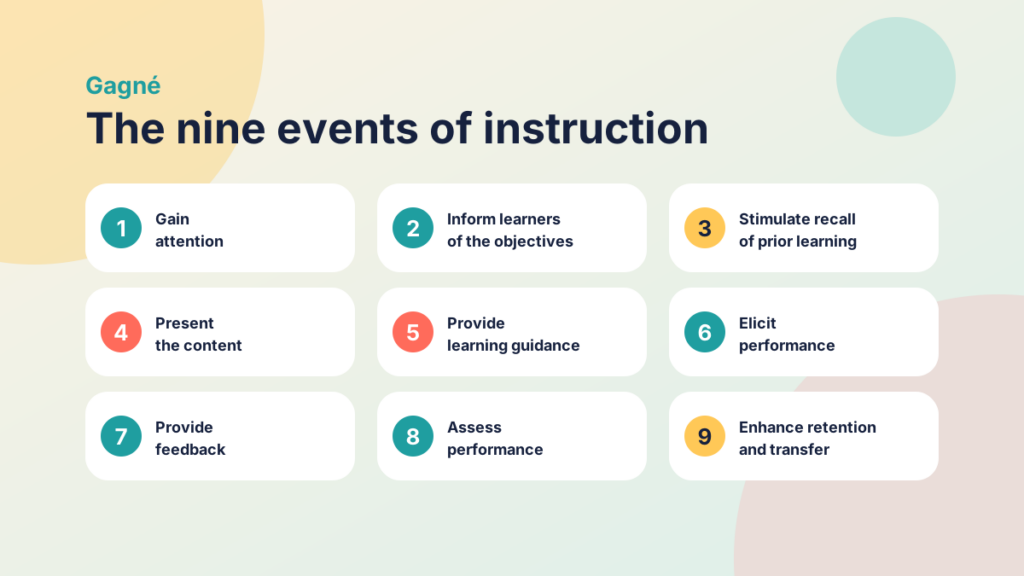
- Gain attention.
- Inform learners of the objectives.
- Stimulate recall of prior learning.
- Present the content.
- Provide learning guidance.
- Elicit performance.
- Provide feedback.
- Assess performance.
- Enhance retention and transfer.
Two features of Gagné’s approach are worth noting. First, the events form a sequence that fits naturally around a single lesson or learning episode. Second, Gagné also distinguished several categories of learning outcome, including verbal information, intellectual skills, cognitive strategies, motor skills and attitudes. He argued that different outcomes call for different conditions, so the same event may look quite different depending on what you want students to learn.
Merrill’s First Principles in brief
David Merrill set out his First Principles of Instruction in a 2002 article in Educational Technology Research and Development. He reviewed a range of instructional design theories and described the principles they had in common. His argument was that learning is promoted when these principles are present and is hindered when they are missing. The five principles are:
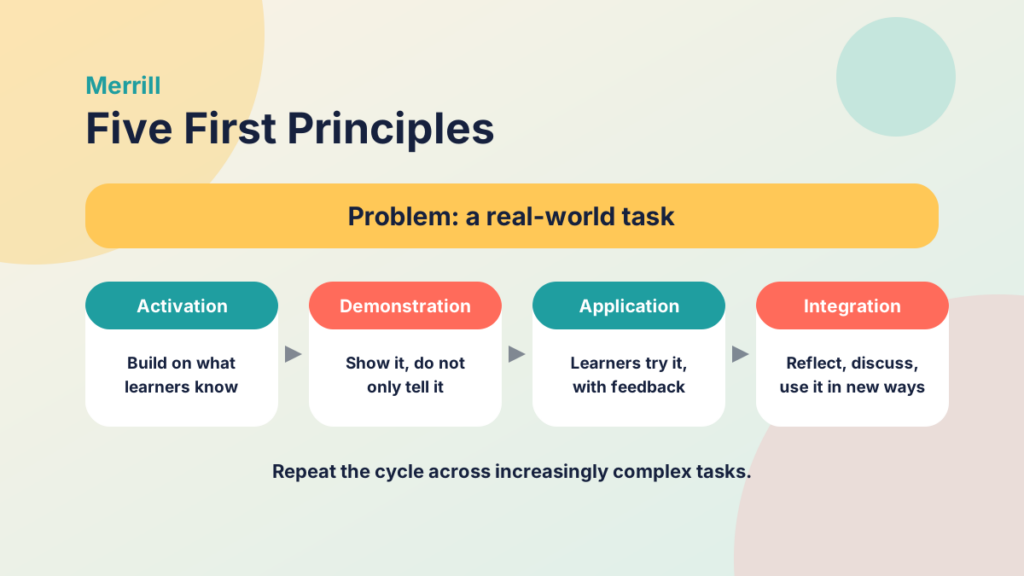
- Problem: learning is promoted when learners engage with real-world problems or tasks.
- Activation: learning is promoted when existing knowledge is activated as a foundation for new knowledge.
- Demonstration: learning is promoted when new knowledge is demonstrated to the learner, not just told.
- Application: learning is promoted when learners apply new knowledge, with feedback.
- Integration: learning is promoted when learners integrate new knowledge into their own world, for example by reflecting, discussing or using it in a new way.
Merrill’s model is often described as task-centred. Instead of starting with a topic, you start with a meaningful task, and the other principles are woven around it. Merrill also suggested that guidance should fade as learners become more capable, and that learners may move through a series of increasingly complex tasks.
Where they agree
Despite their different shapes, the two frameworks share a good deal of ground. Both recognise that:
- Prior knowledge matters. Gagné’s third event and Merrill’s activation principle both ask you to connect new learning to what students already know.
- Telling is not enough. Both expect students to see the new knowledge presented or demonstrated and then to do something with it.
- Practice needs feedback. Gagné includes feedback as an explicit event, and Merrill builds corrective feedback into application.
- Learning should travel. Gagné’s final event concerns retention and transfer, and Merrill’s integration principle asks students to bring new knowledge into their own context.
- Learners are active. Neither model treats students as passive recipients.
This overlap is useful. If you apply either framework carefully, you will already be doing much of what the other recommends.
Where they differ
The differences are more instructive than the similarities. They are not about right and wrong, but about emphasis and starting point.
The starting point: attention or problem
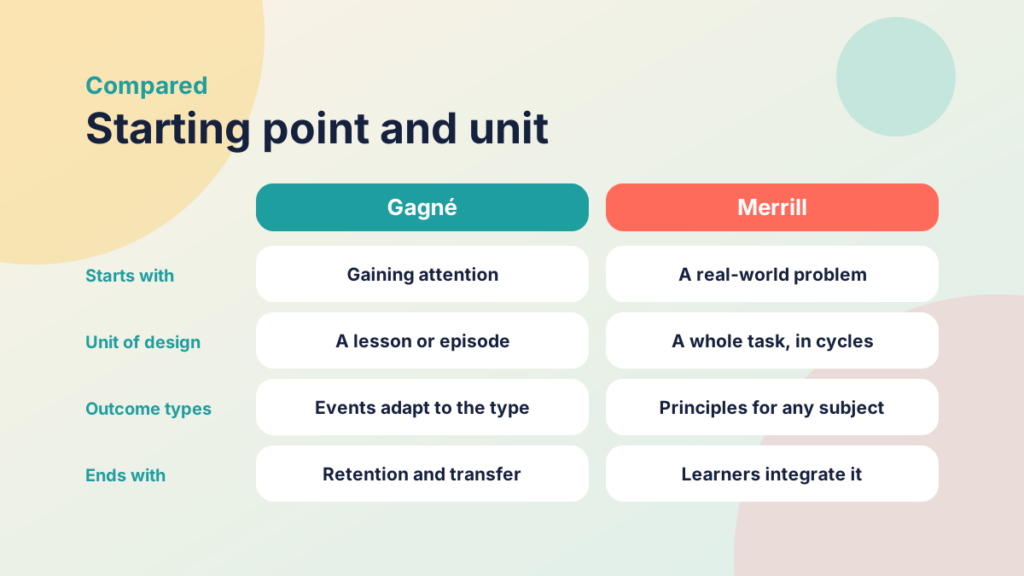
Gagné’s sequence begins by gaining attention and sharing objectives. Merrill begins with a real-world problem. In practice this changes what students meet first. A Gagné-style session might open with a surprising example and a list of outcomes. A Merrill-style session might open with the whole task students will eventually be able to complete, so that the rest of the learning has an obvious purpose.
The unit of design: lesson or task
Gagné’s events are most naturally applied to a lesson. Merrill’s principles are often applied to a whole task or a sequence of tasks, with the demonstration and application phases repeating as complexity increases. If your course is built around projects, cases or authentic assessments, Merrill’s task-centred framing may feel more natural. If you are planning a discrete session on a defined topic, Gagné’s sequence may be easier to apply.
Attention to types of outcome
Gagné’s framework is closely tied to categories of learning outcome, and he argued that different outcomes need different conditions. Merrill’s principles are presented as general principles that apply across approaches and subjects. This means Gagné can help you adapt your design to the kind of learning involved, while Merrill gives you a smaller set of principles to check against.
How learning ends
Gagné ends with assessment and with enhancing retention and transfer. Merrill ends with integration, which puts the weight on learners making the knowledge their own through reflection, discussion or creating something new. Both aim at transfer, but Merrill’s wording places more emphasis on what the learner does, and Gagné’s wording gives more weight to what the designer arranges.
Try it yourself
Gagné, Merrill or both?
Read each statement and decide which framework it describes. Choose Gagné, Merrill, or Both when the idea appears in each.
Mapping them side by side
It helps to see how the pieces line up. The mapping below is approximate, and it reflects one reasonable reading rather than an official correspondence, since the two models were not designed to fit together.
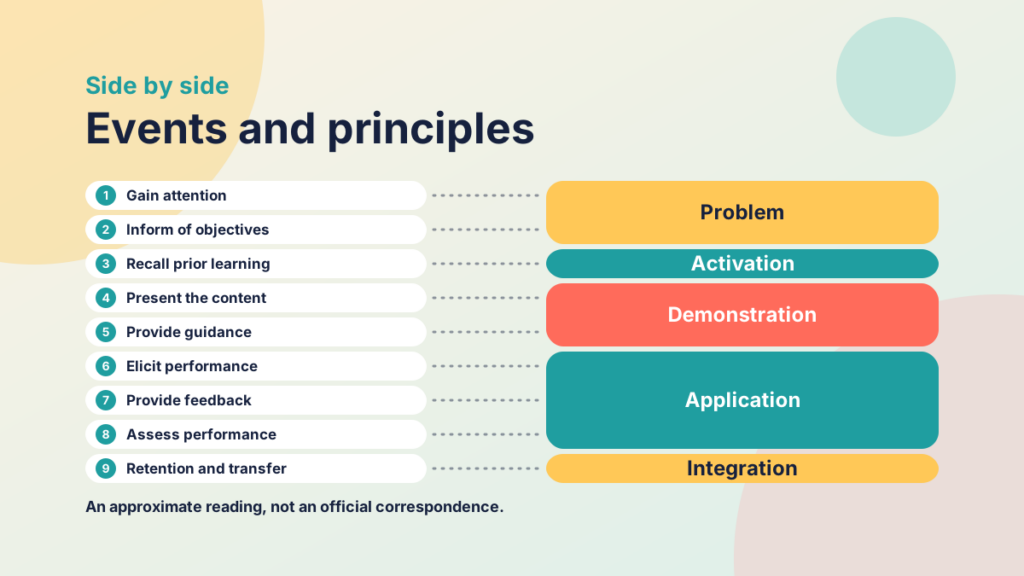
- Problem sits close to Gagné’s events 1 and 2, gaining attention and informing learners of objectives, although a real task does more than an objective statement.
- Activation matches event 3, stimulating recall of prior learning.
- Demonstration matches events 4 and 5, presenting content and providing guidance.
- Application matches events 6, 7 and 8, eliciting performance, giving feedback and assessing performance.
- Integration matches event 9, enhancing retention and transfer.
Notice what the mapping hides. Gagné lists assessment as its own event, while Merrill folds feedback and practice into application. Merrill also puts the problem first and keeps returning to it, which has no direct counterpart in Gagné’s sequence.
Try it yourself
Map each lesson step
A session on writing a short literature review has six steps. For each one, choose the Merrill principle and the Gagné event it most closely serves. The mapping is approximate, so some steps accept more than one event.
A worked example: teaching a short literature review
Suppose you want students to write a short literature review. The two models lead you to plan the session in slightly different ways.
A Gagné reading
You might open with a striking example of a review that changed how a field thought about a question (attention), then state that students will be able to synthesise three sources (objectives). A quick recall activity on how to find and cite sources follows (prior learning). You present the structure of a review and offer a template (content and guidance), ask students to draft a paragraph (performance), give comments (feedback), and mark the paragraph against criteria (assessment). Finally, you ask students to plan how they will use the same approach in their own project (retention and transfer).
A Merrill reading
You might begin by showing students the finished task: a short review on a topic that matters to their course (problem). You ask what they already know about reading critically (activation). You then demonstrate how a review is built, perhaps thinking aloud as you compare two sources (demonstration). Students try a small version with coaching, and the coaching reduces as they improve (application). They finish by discussing their review with a peer and choosing how to apply the approach to their dissertation question (integration).
Both plans are sound. The first makes the sequence of the session very clear. The second makes the purpose of the whole session clear from the start. Many academics find that they borrow the best of each: Gagné’s careful sequencing of the lesson and Merrill’s insistence on a meaningful task.
Using both with PANDA and Canvas
If you use the PANDA framework (Prepare, Activate, Navigate, Demonstrate and Articulate) to structure a weekly pattern in Canvas, you can use Gagné and Merrill as lenses on the same design. One way to read them together is:
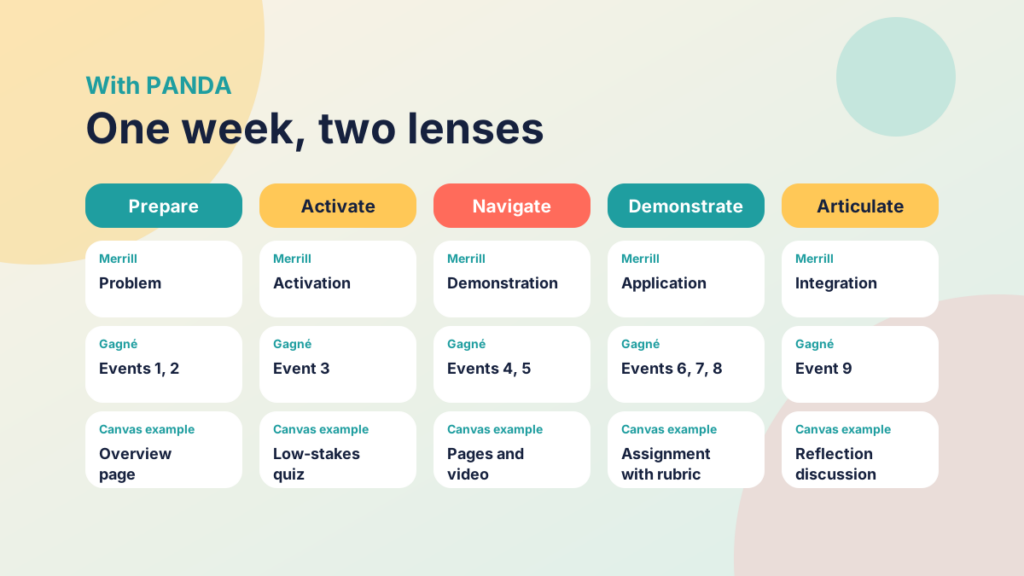
- Prepare: share the week’s task or problem and the outcomes on a clear overview page.
- Activate: prompt recall with a short low-stakes quiz or a discussion where students post before they see replies.
- Navigate: present content in Pages, and show a worked demonstration of the task, perhaps with a short recorded walkthrough.
- Demonstrate: set an assignment or quiz where students attempt the task, with a rubric and feedback.
- Articulate: invite reflection and connection to other learning, for example in a discussion or a short reflective submission.
This is the author’s reading of how the models fit, not a formal mapping from any of the original sources. It is a design aid, and you should adapt it to your discipline.
Which should you choose?
The honest answer is that you do not have to choose. A few rules of thumb can still help.
- Planning a single session? Gagné’s sequence is a handy checklist for the shape of the session.
- Designing around a project, case or authentic task? Merrill’s task-centred principles give you a clearer spine.
- Teaching different kinds of outcome? Gagné’s outcome categories can help you adjust the design.
- Reviewing an existing module? Use Merrill’s five principles as a quick audit, then use Gagné’s events to check the detail.
- Working with colleagues? Pick the model your team already knows, and borrow from the other when you notice a gap.
Cautions and limits
Neither model is a complete theory of learning, and neither guarantees good teaching. A few cautions are worth keeping in mind.
- Do not treat the sequence as a script. Events can be combined, repeated or reordered, and not every session needs every event.
- Do not confuse a checklist with quality. A session can tick every box and still be dull or confusing.
- Be careful with claims of proof. The models are widely used and well regarded, but how well a framework works depends on the subject, the learners and how it is applied.
- Remember context. The models were not written for any particular learning platform, so you will need to translate them into your own tools and constraints.
A short activity to try
Take one session you teach and write down, in one line each, what students do in it. Then label each line with the Gagné event and the Merrill principle it most closely serves. Look for gaps: is there any activation, any feedback, any chance to integrate? Then look for imbalance: is most of the time spent presenting content? Finally, ask whether students ever see the whole task before they are asked to attempt it.
Getting started
You do not need to adopt either model wholesale. Start with the principle that feels most relevant to a problem you already have. If students arrive unprepared, look at activation. If they struggle to apply ideas, look at demonstration and feedback. If they pass but do not remember, look at integration. Over time, comparing the two models becomes less about which is right and more about asking better questions of your own design.